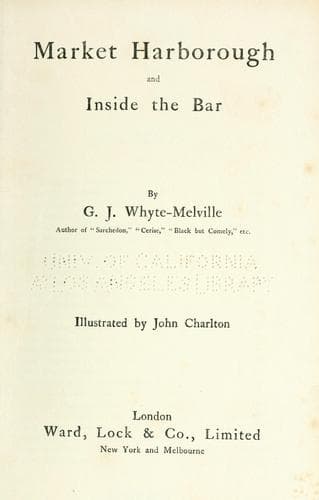
Market Harborough, and Inside the BarWhyte-Melville, G. J. (George John)
General
Market Harborough, and Inside the Bar
Whyte-Melville, G. J. (George John)
Country life -- England -- Fiction; English fiction -- 19th century; Fox hunting -- Fiction
“There are secrets, I am told, in all families—a fact that makes me
additionally grateful that I have got none: I mean, neither family nor
secrets. What arguments were used by the elder Brown in his conferences
with the younger, whether he urged him by threats or plied him with
entreaties, we shall never know. It is sufficient to state that he
gained his point, as such men usually do, and prevailed upon the less
energetic Cornet to give up Miss Merlin. Men vary much in the force of
character, and I hope I know what is the wisest and the most discreet
course to take in most affairs of life; but when I was his age, before I
would have given up such a girl as Fanny Merlin, in consideration of any
amount of threatening, reasoning, or expediency, I would have seen fifty
elder brothers consigned to that place where they would have had an
opportunity of comparing notes with Dives on their terrestrial
prosperity.
“The Cornet, however, gave way, and wrote a most affecting letter to his
ladye-love, in which he assured her of his eternal attachment and
regard, vowing that ‘imperious necessity would alone have induced him to
forego her affection, and that although, at his brother’s injunctions,
he must leave that part of the country, and they would probably not meet
again, yet he could never forget her, and should always look back on
their acquaintance as the happiest period of his life. In conclusion, he
implored her to send him some keepsake, however trifling, that he might
take with him into his banishment—anything that was _her_ gift would be
prized and valued till death,’ etc. etc.
“Miss Merlin was not a young lady to make parade of a sorrow, however
engrossing. She said nothing, and the most curious observer could not
have discovered from her impassive face that she had sustained so cruel
a wound, for she loved the Cornet very dearly, as the sequel proved; but
she complied with her weak-minded swain’s request, and sent him by
return of post the most appropriate present she could think of—namely,
‘a pair of leading-strings and a child’s go-cart’! Brown the elder
positively roared with delight when he heard of this quiet and bitter
sarcasm. But the Cornet took it very much to heart; I do not think he
had seen his own conduct in its true light before.
Public-domain text, read in full here on John Shaqi.
Reviews
Reviews
No reviews yet
Be the first to share your thoughts on this work.
Elsewhere in the archive
Join the Discussion
Join the discussion
Sign in to leave a comment or review.
Sign InorCreate an account