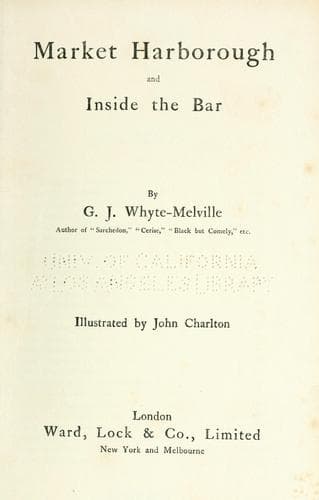
Market Harborough, and Inside the BarWhyte-Melville, G. J. (George John)
General
Market Harborough, and Inside the Bar
Whyte-Melville, G. J. (George John)
Country life -- England -- Fiction; English fiction -- 19th century; Fox hunting -- Fiction
The proprietor of such “a trap,” as he would probably call it, could not
fail to be a study in himself. Loud accents from within smote on my ear
as I approached the bar. The shrill tones of Miss Lushington’s voice
predominated, and I gathered from this that she had recovered her
good-humour, which for the last few days had been most indubitably on
the wane. Entering the _sanctum_, I stood for a few seconds behind the
wooden screen—which I have already mentioned, and which admits of a
new-comer, himself unseen, reconnoitring the occupants of the place—to
survey the visitor whose arrival seemed so acceptable to the presiding
goddess. I had ample time to take a good look at him; for, whilst he
discussed a glass of sherry and a bitter (a glass of sherry and a
bitter—and it was not yet eleven o’clock!), both talker and listener
were so engrossed with the former’s jokes and conversation that I had
entered completely unobserved. He was a stout young man of some
five-and-twenty summers, with a whiskerless face, and a ruddy
complexion, not yet destroyed, though obviously impaired, by his habits
of life. His cheek, still healthy in colour, was mottled here and there,
as if the vessels near the surface were kept habitually too full, and he
already began to show that slight puffiness under the eyes, as if he had
put his neckcloth on too tight, which is the certain symptom of a
digestion impaired by the too liberal use of stimulants. Not that _his_
neckcloth was too tight—far from it. Save a scarlet knot halfway down
his throat, secured by a horse-shoe pin, there was nothing to be seen of
the customary wisp of ribbon which has now replaced that obsolete
article of apparel, so concealed was it by the fall of a turned-down
shirt collar, extremely well starched and of a singularly varied and
gaudy pattern, not unlike the papering of a room. His hat, which he had
not thought it necessary to lay aside, was of the “pork-pie” order,
immortalised by Leech—a head-dress extremely trying to a countenance
already divested by Nature of any particular expression, and which, like
many other graceful eccentricities, looks as ill upon a man as it is
becoming to a woman. Coat and waistcoat, I need hardly observe, were of
a checked pattern, to which, for richness of hue and diversity of
colours, the rainbow of heaven is a mere pale and feeble transparency.
Beneath the latter, knickerbockers of course! formed apparently from
some woollen fabric, designed by the inventor for a horse-cloth, and
combining great strength of wear-and-tear, with an unassuming and
neutral tint. Scarlet hose, imparting fulness to the calf, and general
_contour_ to the leg (in this instance much required, the limbs
themselves being of too massive an order for elegance), sprang from the
voluminous superfluities above, and a pair of exceedingly stout
half-boots, much strapped and pieced, and, as it were, tattooed like the
_mocassins_ of a Red Indian, completed this choice and becoming costume.
Public-domain text, read in full here on John Shaqi.
Reviews
Reviews
No reviews yet
Be the first to share your thoughts on this work.
Elsewhere in the archive
Join the Discussion
Join the discussion
Sign in to leave a comment or review.
Sign InorCreate an account