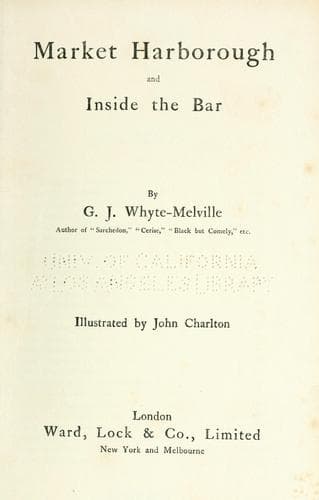
Market Harborough, and Inside the BarWhyte-Melville, G. J. (George John)
General
Market Harborough, and Inside the Bar
Whyte-Melville, G. J. (George John)
Country life -- England -- Fiction; English fiction -- 19th century; Fox hunting -- Fiction
Old Plumtree was grievously disappointed, of course. By the way, I know
very few cases in which sons do not disappoint their fathers. I suppose
it would be difficult to persuade the latter that the former are not
exclusively in fault. Old Squaretoes lays down a course of conduct for
his child, totally irrespective of the feelings, inclination, and
disposition of the latter. Then, if young Squaretoes don’t fit the
groove, and slide easily down the metal, he is undutiful, disobedient,
ungrateful, everything that the Prodigal Son was, before he came to
eating husks amongst the swine. If young S. turn out “slow,” ten to one
but old S., in suicidal folly, wishes he “had a spice more devil in
him.” If he be fast, the governor shakes in his shoes, foreseeing debts,
bills, acceptances, renewals, and eventual penury. If he make a figure
in the world on his own wings, taking warning by Icarus, and scorning to
use the paternal pinions, his father is often jealous of his success.
If, on the contrary, he remain in secure and humble obscurity, then the
cry is, “Why, the lad has no spirit in him! Look at what I should have
done at his age, _and with his advantages_!” Good masters make good
servants. Unselfish and considerate fathers, more than people are aware
of, make attached and dutiful sons.
So Jovial Jem came home, and took up his abode at The Ashes, completely
upsetting the regularity of that establishment, where, in his absence,
everything went on like clockwork. For his own sake, Mr. Plumtree senior
gave his son a couple of rooms, shut off from the rest of the mansion by
double doors of baize, through which the fumes of latakia could not
possibly penetrate, and ordered the domestics to serve their young
master with breakfast and dinner at his own hours, when required, in his
own apartments. By this arrangement, the heir was wonderfully little in
his father’s way; and unless the pair happened to meet on a summer’s
morning, when the old one was going to his hay-field, fresh and rosy,
and the young one returning from a junketing, pale and exhausted, father
and son often did not see each other for weeks. Consequently, they got
on admirably. Young Plumtree swore “The Governor was a dear old bird;
crotchety of course, but a regular brick nevertheless;” and old
Plumtree, who always took a solemn pinch of snuff before he delivered
himself of a remark, was fond of stating, very slowly and distinctly,
that “Young men won’t settle at once. Can’t expect it, sir—can’t expect
it! But the lad’s got something in him. If we could only get _at_ it,
sir! if we could only get _at_ it!”
Public-domain text, read in full here on John Shaqi.
Reviews
Reviews
No reviews yet
Be the first to share your thoughts on this work.
Elsewhere in the archive
Join the Discussion
Join the discussion
Sign in to leave a comment or review.
Sign InorCreate an account