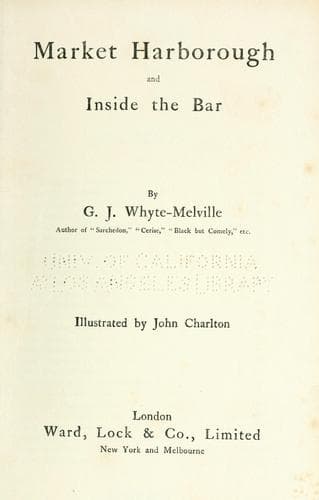
Market Harborough, and Inside the BarWhyte-Melville, G. J. (George John)
General
Market Harborough, and Inside the Bar
Whyte-Melville, G. J. (George John)
Country life -- England -- Fiction; English fiction -- 19th century; Fox hunting -- Fiction
“Never seen her!” repeated both ladies in tones of the utmost surprise;
but while Rebecca’s emphasis denoted simple astonishment, I was
concerned to detect in that of Jane a covert reproach and contempt. What
must a young lady of her gifts and acquirements have thought of so
recreant a knight as myself? They are all alike, you see—these ladies;
repudiating very judiciously, as an established principle, too great
diffidence in our sex, and readier far to forgive us when erring in the
opposite extreme. The Bissextile, or Leap-year, does not come often
enough to allow their taking the initiative as a regular thing; so a
backward swain is like a jibbing horse—the very worst description of
animal you can drive, either for single or double harness, light or
heavy draught.
“And what do you think of our hounds, Mr. Softly?” said old Plumtree,
now putting in a word, as he sent the bottles round a second time; a
signal for the young ladies to depart, and for me to open the door to
let them out—a manœuvre I accomplished with the best grace I could
muster, and an uncomfortable conviction that they might, and probably
_would_ talk me over, not without critical disapproval, immediately they
were settled in the drawing-room.
As we took our seats round the fire, which sparkled pleasantly amongst
the glasses and decanters on the little round table, my host repeated
his question, adding, whilst his son almost imperceptibly elevated his
eyebrows, “Don’t you think now, _as_ a sportsman, that we’re all
inclined to breed hounds a little too fast?”
This was obviously old Plumtree’s crotchet, and I resigned myself to my
fate.
“You must get pretty quick after a fox _some_ part of the day, if you’ve
a mind to kill him,” I replied; because I had heard a huntsman once say
something of the same kind. And Jem likewise put in his oar with the
remark, that “slow hounds, in these days, would never get from under the
horses’ feet”—an observation received by his father with that silent
contempt which a man would consider extremely rude to a stranger, but
which, nevertheless, he does not scruple to betray towards those who
have the advantage of belonging to his own family.
Public-domain text, read in full here on John Shaqi.
Reviews
Reviews
No reviews yet
Be the first to share your thoughts on this work.
Elsewhere in the archive
Join the Discussion
Join the discussion
Sign in to leave a comment or review.
Sign InorCreate an account