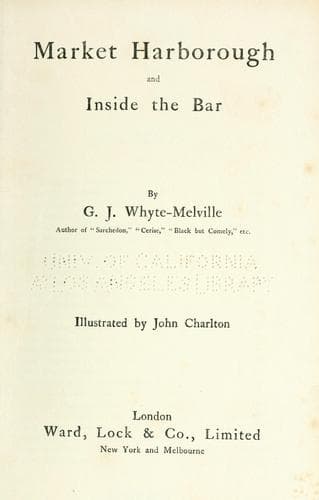
Market Harborough, and Inside the BarWhyte-Melville, G. J. (George John)
General
Market Harborough, and Inside the Bar
Whyte-Melville, G. J. (George John)
Country life -- England -- Fiction; English fiction -- 19th century; Fox hunting -- Fiction
The rail, though not high, was strong and ugly. There was a nasty deep
blind ditch on the taking-off side, and nothing but gorse-bushes to land
in. I did not seem to care much about entering the covert at this point;
but whilst I was deliberating the matter in my own mind, and Tipple
Cider was doing all he could to get at the rail, tail first or anyhow, a
horn resounded from the opposite side of the covert; the music of the
hounds running, which had greeted us ever since we got within ear-shot,
suddenly ceased: though I could see nothing of them, I could distinctly
hear the rush of horses galloping up the adjacent pasture. It was
evident they had gone away; and equally incontestable that we had lost
our start. Tips blazed up into excitement at once; he made no more ado,
but caught the four-year-old short by the head, rammed both spurs in,
and, notwithstanding an abortive kick or two, forced him over the rail,
striking it hard with fore and hind legs. Tipple Cider, fired with
emulation, took the bit in his teeth, and had me over it, clear and
clean, before I was aware. The next instant, leaping and plunging
through the gorse-bushes, I was following Tips at the best pace I could
muster, to get after the hounds.
My blood rose with the motion, my horse dropped to his bit, my pilot
chose an easy, though devious path; if everything had gone right, I
think at that moment I could have ridden fairly and boldly enough.
As we rounded the slight acclivity on which the gorse was planted, a
beautiful panorama was spread out before us. Already two fields ahead,
the hounds were running hard, evidently with a capital scent, followed
at different intervals by the scattering field, all fresh as fire, and
every man taking the place to which he felt his skill and daring
entitled him. Nearest ourselves I recognised Mr. Naggett, striding away
on the mealy chestnut with a great display of enthusiasm and hard
riding, his feet stuck out, his elbows up to his ears, and his blue
coat-tails flying in the wind. He was diverging, nevertheless, slightly
from the line of chase, and making vigorously for the gate, which old
Ike, whose active feet had already taken him there, was hurriedly
unfastening. Two or three dark coats and the second whip seemed also
inclined to avail themselves of this convenient egress; the body of the
field, however, were charging the fence boldly (a fair hedge and ditch),
making for the places that had been leaped by their leaders in the first
flight. I saw Plumtree jump it on his steady hunter; but I observed by
the way in which he pulled the old horse out of his stride, upsetting
the equanimity even of that experienced animal, that his nerves were by
no means up to the mark. The Earl and Will Hawke, a hundred yards or so
ahead of these, were close to the hounds. “Pop,” too, on the white
horse, had got a capital start, and was blazing away as if he had a
second horse in every field, and a spare neck in his pocket. Rather in
Public-domain text, read in full here on John Shaqi.
Reviews
Reviews
No reviews yet
Be the first to share your thoughts on this work.
Elsewhere in the archive
Join the Discussion
Join the discussion
Sign in to leave a comment or review.
Sign InorCreate an account