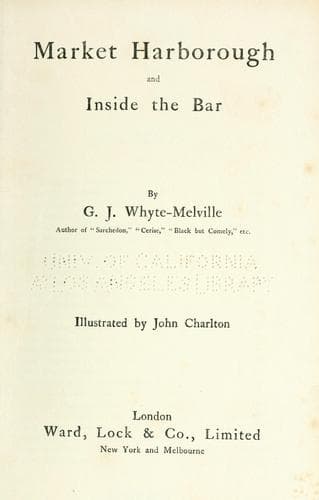
Market Harborough, and Inside the BarWhyte-Melville, G. J. (George John)
General
Market Harborough, and Inside the Bar
Whyte-Melville, G. J. (George John)
Country life -- England -- Fiction; English fiction -- 19th century; Fox hunting -- Fiction
Perhaps the reason is, that in these fast times condition is so much
better understood—for we cannot admit the uncomplimentary excuse that
hounds do not run now as formerly—why horses _stop_ so much less often
in the hunting-field than they did in the palmy days of Musters and
Assheton Smith, and “the d—d Quornites,” who were always either
“showing” or “being shown the _trick_” some fifty years ago. _Then_ a
hunter’s reputation was as fragile as a sultana’s, and was guarded as
jealously. Not only must he be “_sans peur_,” but also “_sans
reproche_.” And the efforts of these lords to preserve the character of
their treasures were as ingenious as they were ludicrous. One facetious
nobleman actually got a tired favourite home next day right through the
streets of Melton, disguised as the middle horse of a cart-team; nor did
all the lynx-eyes, ready to watch for the “casualties” consequent on a
clipper, discover the identity of one of the best nags in
Leicestershire, under the weather-beaten winkers and shabby harness of a
four-horse waggon. Mr. Sawyer trusted to the cloud of night for the same
immunity.
He had just stabled his steed in the warmest corner of the shed, and,
having taken off his own coat to fling over the animal’s heaving
quarters, was beginning to speculate on the probable rheumatism that
would succeed this imprudence, when, to his astonishment and disgust,
the door was darkened by another figure, and his solitude disturbed by
the entrance of a man and horse, in all probability seeking the same
shelter for the same cause.
The new-comer was a remarkably good-looking person, extremely well
got-up, particularly as regarded his nether extremities, and our friend
at once recognised him as having been very forward with the hounds at
different stages of the run. His horse, a well-bred bay, was “done to a
turn.” When Sawyer looked at its drooping head and heaving flanks, it
seemed to put him quite in conceit with the roan. For a moment neither
spoke a word—then the absurdity of the situation seemed to strike them
simultaneously, and they both burst out laughing.
“What? They’ve cooked _your_ goose as well as mine!” said the stranger,
in off-hand tones, producing at the same time a silver cigar-case, on
which our friend could not help fancying he descried a coronet, and
proceeding to light a most tempting-looking weed.
“A very likely day to do it, too,” he added, glancing, as Sawyer
thought, somewhat contemptuously at himself and steed. “The pace for the
first twenty minutes was _alarming_, and the country awfully deep. I
should say you’ll hardly get that horse home to-night.”
The suggestion was neither flattering nor consolatory. Mr. Sawyer felt
half inclined to be offended; but he thought of the silver cigar-case,
and swallowed the retort uncourteous that rose to his lips. He was a
true Briton, and not above a weakness for the peerage. “This
good-looking man,” he argued, “notwithstanding his black coat, must be a
Viscount at least!”
Public-domain text, read in full here on John Shaqi.
Reviews
Reviews
No reviews yet
Be the first to share your thoughts on this work.
Elsewhere in the archive
Join the Discussion
Join the discussion
Sign in to leave a comment or review.
Sign InorCreate an account