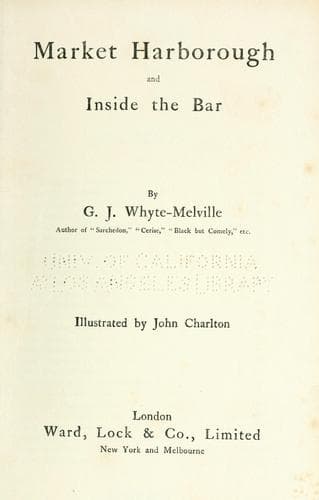
Market Harborough, and Inside the BarWhyte-Melville, G. J. (George John)
General
Market Harborough, and Inside the Bar
Whyte-Melville, G. J. (George John)
Country life -- England -- Fiction; English fiction -- 19th century; Fox hunting -- Fiction
Crasher fell back apparently satisfied. It was evident he did not attach
so much importance to the act of “exchange or barter” as did our friend.
Mr. Sawyer picked himself up without loss of time. “I shouldn’t like to
sell him to _everybody_,” said he affectionately, “but if you fancy him
very much, I wouldn’t mind letting you have him,” he added, after a
pause, and in the tone of a man who makes a painful sacrifice in the
cause of friendship.
“I’ll give you two hundred and fifty for him,” drawled out the
Honourable, with apparently about as much interest as he would have felt
in paying three-and-sixpence for a pair of gloves.
“Guineas!” stipulated Mr. Sawyer; “Guineas,” was the answer; and in this
simple manner the deal was concluded.
My readers will agree with Isaac and his master, in thinking that
Marathon was not the only one of the party who was pretty well sold. The
old groom laughed in his sleeve a week afterwards, when he heard that on
giving him “a spin” with Chance, just to keep his pipes clear, the mare
went away from him as if he was standing still.
Mr. Tiptop couldn’t make it out at all.
------------------------------------------------------------------------
CHAPTER XVII
“TEMPTED TO BUY”
AND now for the well-pleased John Standish Sawyer, came in what may be
called the “sweet of the day.” His horse disposed of, two hundred and
sixty-two pounds ten shillings in his pocket (for the Honourable
Crasher’s word was as good as a bank-bill), and the wiry little grey
under him, an animal for which he had not given a fourth of the above
sum, and yet in whose pace and fencing he had the utmost confidence,
with the additional delight of a certain find for the second fox—all
these influences combined, were enough to put a man in thorough
good-humour with himself. To do our friend justice, he was not of a
mercenary disposition; but having been kept exceedingly short of funds
during his youth, and in those hard times hunted under considerable
pecuniary difficulties, he had insensibly imbibed a horror of what he
called “riding upon too much money.” “A man must have good nerve,” he
used to say, “who is not afraid to risk a couple of hundred every time
he jumps a fence;” and I really believe he would shove a forty-pound
screw along with greater satisfaction than the winner of the Liverpool.
The grey was a right good little nag, easy to turn, quick at his fences,
and thoroughly accustomed to his master’s hand. It is wonderful what a
deal of time is saved by a horse that is pleasant to ride, and how
rapidly a moderate galloper, with a fine mouth, and quick upon his legs,
can slip over a country compared with an animal that may have the pace
of a racehorse, but requires a segundo bridle, and a hundred-acre field
to turn him in. Mr. Sawyer drew the curb-rein gently through his
fingers, struck his heels down, and mingled in the crowd upon the best
possible terms with himself.
Public-domain text, read in full here on John Shaqi.
Reviews
Reviews
No reviews yet
Be the first to share your thoughts on this work.
Elsewhere in the archive
Join the Discussion
Join the discussion
Sign in to leave a comment or review.
Sign InorCreate an account