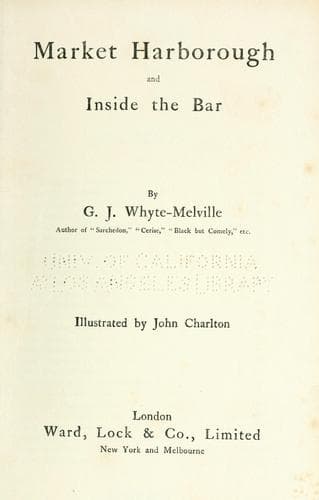
Market Harborough, and Inside the BarWhyte-Melville, G. J. (George John)
General
Market Harborough, and Inside the Bar
Whyte-Melville, G. J. (George John)
Country life -- England -- Fiction; English fiction -- 19th century; Fox hunting -- Fiction
LET us take a peep into Dove-cote Rectory, smiling in the wintry sun, as
it lies snugly sheltered from the north winds by a thick plantation, and
rejoicing in that most desirable advantage in our climate—a southern
aspect. This house is one that would make any sportsman oblivious of the
tenth commandment. Who could refrain from coveting possession of those
cheerful rooms; that fine extensive view; above all, the excellent and
commodious stables within reach of three packs of hounds, and situated
in the best grass country in England?
It is however with the _inside_ of the mansion that we have now to do,
and with those gentle beings who constitute a home, without whom a
palace is little better than a dungeon.
Breakfast has been over at the Dove-cote for an hour or so. Cissy and
her mamma have established themselves in what they call “the little
drawing-room”—a snug apartment of small dimensions, with windows opening
to the ground, and “giving,” as the French say, on a neatly laid-out
garden, in spring and summer the peculiar care of the daughter of the
house. To-day, however, flowers and blossoms are replaced by a million
sparkling gems, formed by last night’s white frost, which is melting
rapidly under the noon-day sun. Inside, the furniture is of a rich and
somewhat gaudy pattern, assorting well with the rose-tinted muslin
curtains and multiplicity of looking-glasses, which are so
characteristic of a lady’s bower; whilst a thousand pretty knick-knacks,
and a graceful litter of books, music, work, paper-lights, stray gloves,
and gossamer handkerchiefs betray at once the sex of the occupants. A
little statuette of a Cupid in tears, with nothing on but a quiver,
occupies a niche between the windows, under a portrait of Miss Dove,
depicted by the artist in a graceful attitude on the chestnut horse,
attired in a blue riding-habit, with her hat off, and her hair falling
about her shoulders, as, it is only right to observe, she is _not_ in
the habit of wearing it when taking equestrian exercise. Altogether the
painter’s idea seems to have been borrowed from a French print entitled
“The Rendezvous,” representing a disconsolate damsel waiting for a
gentleman in a wood—not in the best of humours, as is natural under the
circumstances,—and sitting her white horse in a listless, woe-begone
attitude, unworthy of an Amazon. The laggard, however, is perceptible in
the far distance, making up for lost time on an exceedingly bad goer,
whose “form” must at once absolve him of intentional unpunctuality in
the eyes of his ladye-love. As a _pendant_ to this work of art, hangs a
portrait in _crayons_ of Mrs. Dove, done some years ago, when people
wore bunches of ringlets and a high comb at the back of the head—a
fashion by no means unbecoming to the original, who must have been a
sufficiently handsome young woman when she sat for this likeness.
Indeed, the Reverend, no mean judge of “make-and-shape,” always declared
Public-domain text, read in full here on John Shaqi.
Reviews
Reviews
No reviews yet
Be the first to share your thoughts on this work.
Elsewhere in the archive
Join the Discussion
Join the discussion
Sign in to leave a comment or review.
Sign InorCreate an account