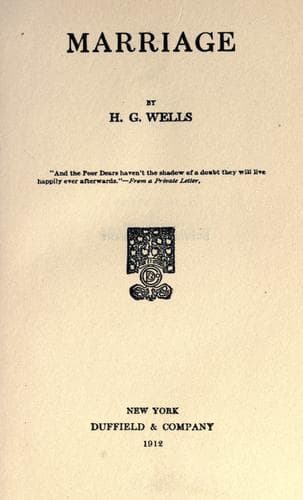
Labrador (N.L.) -- Fiction; London (England) -- Fiction; Love stories, English
When he had accepted the minor Professorship which gave him a footing in
the world of responsible scientific men, she had taken a house in a
quiet street in Chelsea which necessitated a daily walk to his
laboratory. It was a little old Georgian house with worn and graceful
rooms, a dignified front door and a fine gateway of Sussex ironwork much
painted and eaten away. She arranged it with great care; she had kept
most of her furniture, and his study had his father's bureau, and the
selfsame agate paper-weight that had pressed the unfinished paper he
left when he died. She was a woman of persistent friendships, and there
came to her, old connections of those early times trailing fresher and
younger people in their wake, sons, daughters, nephews, disciples; her
son brought home all sorts of interesting men, and it was remarkable to
her that amidst the talk and discussion at her table, she discovered
aspects of her son and often quite intimate aspects she would never have
seen with him alone.
She would not let herself believe that this Indian summer of her life
could last for ever. He was no passionless devotee of research, for all
his silence and restraints. She had seen him kindle with anger at
obstacles and absurdities, and quicken in the presence of beauty. She
knew how readily and richly he responded to beauty. Things happened to
have run smoothly with him so far, that was all. "Of course," she said,
"he must fall in love. It cannot be long before he falls in love."
Once or twice that had seemed to happen, and then it had come to
nothing....
She knew that sooner or later this completion of his possibilities must
come, that the present steadfastness of purpose was a phase in which
forces gathered, that love must sweep into his life as a deep and
passionate disturbance. She wondered where it would take him, whether it
would leave him enriched or devastated. She saw at times how young he
was; she had, as I suppose most older people have about their juniors,
the profoundest doubt whether he was wise enough yet to be trusted with
a thing so good as himself. He had flashes of high-spirited
indiscretion, and at times a wildfire of humour flared in his talk. So
far that had done no worse for him than make an enemy or so in
scientific circles. But she had no idea of the limits of his
excitability. She would watch him and fear for him--she knew the
wreckage love can make--and also she desired that he should lose nothing
that life and his nature could give him.
§ 3
Public-domain text, read in full here on John Shaqi.
Reviews
Reviews
No reviews yet
Be the first to share your thoughts on this work.
Elsewhere in the archive
Join the Discussion
Join the discussion
Sign in to leave a comment or review.
Sign InorCreate an account