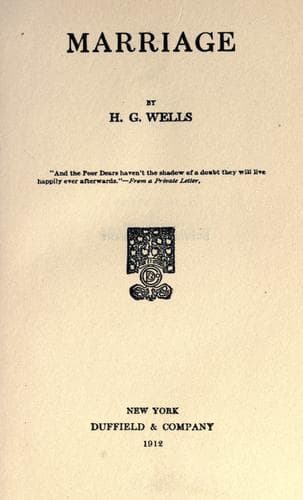
Labrador (N.L.) -- Fiction; London (England) -- Fiction; Love stories, English
He maintained that in the face of Buzard's animated protest. Buzard
glanced at their moral qualities. "More moral!" cried Dover, "more
self-restraint! Not a bit of it! Their desires and passions are weaker
even than their controls; that's all. Weaken restraints and they show
their quality. A drunken woman is far worse than a drunken man. And as
for their biological significance----"
"They are the species," said Buzard, "and we are the accidents."
"They are the stolon and we are the individualized branches. They are
the stem and we are the fruits. Surely it's better to exist than just
transmit existence. And that's a woman's business, though we've fooled
and petted most of 'em into forgetting it...."
He proceeded to an attack on the intellectual quality of women. He
scoffed at the woman artist, at feminine research, at what he called the
joke of feminine philosophy. Buzard broke in with some sentences of
reply. He alleged the lack of feminine opportunity, inferior education.
"You don't or won't understand me," said Dover. "It isn't a matter of
education or opportunity, or simply that they're of inferior capacity;
it lies deeper than that. They don't _want_ to do these things. They're
different."
"Precisely," ejaculated Buzard, as if he claimed a score.
"They don't care for these things. They don't care for art or
philosophy, or literature or anything except the things that touch them
directly. That's their peculiar difference. Hunger they understand, and
comfort, and personal vanity and desire, furs and chocolate and
husbands, and the extreme importance conferred upon them by having
babies at infrequent intervals. But philosophy or beauty for its own
sake, or dreams! Lord! no! The Mahometans know they haven't souls, and
they say it. We know, and keep it up that they have. Haven't all we
scientific men had 'em in our laboratories working; don't we know the
papers they turn out? Every sane man of five and forty knows something
of the disillusionment of the feminine dream, but we who've had the
beautiful creatures under us, weighing rather badly, handling rather
weakly, invariably missing every fine detail and all the implications of
our researches, never flashing, never leaping, never being even
thoroughly bad,--we're specialists in the subject. At the present time
there are far more educated young women than educated young men
available for research work--and who wants them? Oh, the young
professors who've still got ideals perhaps. And in they come, and if
they're dull, they just voluminously do nothing, and if they're bright,
they either marry your demonstrator or get him into a mess. And the
work----? It's nothing to them. No woman ever painted for the love of
painting, or sang for the sounds she made, or philosophized for the sake
of wisdom as men do----"
Buzard intervened with instances. Dover would have none of them. He
displayed astonishing and distinctive knowledge. "Madame Curie,"
clamoured Buzard, "Madame Curie."
Public-domain text, read in full here on John Shaqi.
Reviews
Reviews
No reviews yet
Be the first to share your thoughts on this work.
Elsewhere in the archive
Join the Discussion
Join the discussion
Sign in to leave a comment or review.
Sign InorCreate an account