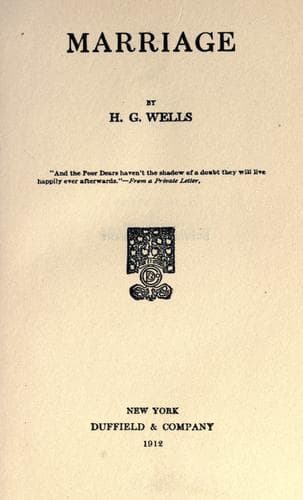
Labrador (N.L.) -- Fiction; London (England) -- Fiction; Love stories, English
Pursuing this line of thought he passed from the politicians and
practical workers to the economists and sociologists. He spent the
entire leisure of the second summer after the establishment of the
factory upon sociological and economic literature. At the end of that
bout of reading he attained a vivid realization of the garrulous badness
that rules in this field of work, and the prevailing slovenliness and
negligence in regard to it. He chanced one day to look up the article on
Socialism in the new Encyclopædia Britannica, and found in its entire
failure to state the case for or against modern Socialism, to trace its
origins, or to indicate any rational development in the movement, a
symptom of the universal laxity of interest in these matters. Indeed,
the writer did not appear to have heard of modern Socialism at all; he
discussed collective and individualist methods very much as a rather
ill-read schoolgirl in a hurry for her college debating society might
have done. Compared with the treatment of engineering or biological
science in the same compilation, this article became almost symbolical
of the prevailing habitual incompetence with which all this system of
questions is still handled. The sciences were done scantily and
carelessly enough, but they admitted at any rate the possibility of
completeness; this did not even pretend to thoroughness.
One might think such things had no practical significance. And at the
back of it all was Dowd, remarkably more impatient each year, confessing
the failure of parliamentary methods, of trades unionism, hinting more
and more plainly at the advent of a permanent guerilla war against
capital, at the general strike and sabotage.
"It's coming to that," said Dowd; "it's coming to that."
"_What's the good of it?_" he said, echoing Trafford's words. "It's a
sort of relief to the feelings. Why shouldn't we?"
§ 3
But you must not suppose that at any time these huge grey problems of
our social foundations and the riddle of intellectual confusion one
reaches through them, and the yet broader riddles of human purpose that
open beyond, constitute the whole of Trafford's life during this time.
When he came back to Marjorie and his home, a curtain of unreality fell
between him and all these things. It was as if he stepped through such
boundaries as Alice passed to reach her Wonderland; the other world
became a dream again; as if he closed the pages of a vivid book and
turned to things about him. Or again it was as if he drew down the blind
of a window that gave upon a landscape, grave, darkling, ominous, and
faced the warm realities of a brightly illuminated room....
Public-domain text, read in full here on John Shaqi.
Reviews
Reviews
No reviews yet
Be the first to share your thoughts on this work.
Elsewhere in the archive
Join the Discussion
Join the discussion
Sign in to leave a comment or review.
Sign InorCreate an account