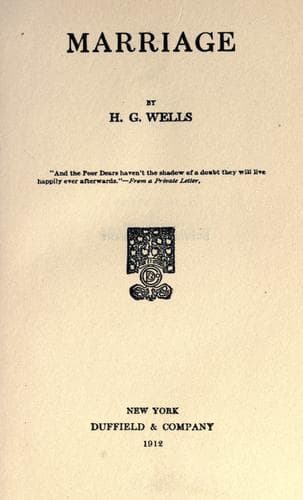
Labrador (N.L.) -- Fiction; London (England) -- Fiction; Love stories, English
It was only after they had been married six or seven years that Trafford
began to realize how widely his attitudes to Marjorie varied. He emerged
slowly from a naïve unconsciousness of his fluctuations,--a naïve
unconsciousness of inconsistency that for most men and women remains
throughout life. His ruling idea that she and he were friends, equals,
confederates, knowing everything about each other, co-operating in
everything, was very fixed and firm. But indeed that had become the
remotest rendering of their relationship. Their lives were lives of
intimate disengagement. They came nearest to fellowship in relation to
their children; there they shared an immense common pride. Beyond that
was a less confident appreciation of their common house and their joint
effect. And then they liked and loved each other tremendously. They
could play upon each other and please each other in a hundred different
ways, and they did so, quite consciously, observing each other with the
completest externality. She was still in many ways for him the bright
girl he had admired in the examination, still the mysterious dignified
transfiguration of that delightful creature on the tragically tender
verge of motherhood; these memories were of more power with him than the
present realities of her full-grown strength and capacity. He petted and
played with the girl still; he was still tender and solicitous for that
early woman. He admired and co-operated also with the capable, narrowly
ambitious, beautiful lady into which Marjorie had developed, but those
remoter experiences it was that gave the deeper emotions to their
relationship.
The conflict of aims that had at last brought Trafford from scientific
investigation into business, had left behind it a little scar of
hostility. He felt his sacrifice. He felt that he had given something
for her that she had had no right to exact, that he had gone beyond the
free mutualities of honest love and paid a price for her; he had
deflected the whole course of his life for her and he was entitled to
repayments. Unconsciously he had become a slightly jealous husband. He
resented inattentions and absences. He felt she ought to be with him and
orient all her proceedings towards him. He did not like other people to
show too marked an appreciation of her. She had a healthy love of
admiration, and in addition her social ambitions made it almost
inevitable that at times she should use her great personal charm to
secure and retain adherents. He was ashamed to betray the resentments
thus occasioned, and his silence widened the separation more than any
protest could have done....
Public-domain text, read in full here on John Shaqi.
Reviews
Reviews
No reviews yet
Be the first to share your thoughts on this work.
Elsewhere in the archive
Join the Discussion
Join the discussion
Sign in to leave a comment or review.
Sign InorCreate an account