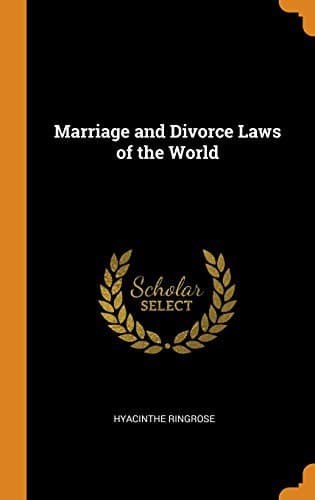
Marriage and Divorce Laws of the WorldRingrose, Hyacinthe
History
Marriage and Divorce Laws of the World
Ringrose, Hyacinthe
Divorce -- Law and legislation; Marriage law
4. Those who have been condemned as authors, or as the author and
accomplice, of the death of the spouse of either of them.
CELEBRATION OF MARRIAGE.--A civil marriage must be celebrated according to
the requirements of the code, as changed or modified by subsequent orders,
decrees and legislation.
Any clergyman, priest or minister, irrespective of faith or sect, who
belongs to a religious denomination actually established in the Republic
of Cuba, and who has been duly authorized, may solemnize marriage.
A register is kept in the office of the Secretary of Justice containing
the names and addresses of all clergymen, priests and ministers who are
qualified to solemnize marriage in the Republic.
Persons who desire to contract a religious marriage must present to the
clergyman, priest or minister who is qualified to perform the ceremony a
declaration signed by both of the contracting parties, stating:
1. The names, surnames, profession, domicile or residence of the
contracting parties.
2. The names, surnames, profession, domicile or residence of the parents.
3. Certificates of birth and of the status of the contracting parties,
the consent or advice, if proper, and the dispensation, when it is
necessary.
Upon the presentation of such a declaration the clergyman, priest or
minister shall announce the future celebration of marriage between the
parties according to the form or method prescribed by the rites and
regulations of his religious denomination.
If the religions denomination of such clergyman, priest or minister has no
established form for such announcement, then a publication must be made in
the form established by the Civil Code. The method required by the Civil
Code for proclaiming an intended marriage is set forth in Article 89,
which directs a publication by posting the written declaration of the
parties for fifteen days and calling upon those who have information of
any obstacle to oppose the marriage.
A civil marriage can only be solemnized by a municipal judge (_Juez
Municipal_), to whom must be presented as an indispensable preliminary
such a signed declaration of the parties as is necessary in the case where
the parties desire a religious ceremony.
A municipal judge chosen to celebrate a civil marriage will also direct as
a preliminary to marriage such a proclamation as is required by Article 89
aforesaid.
A priest, minister or clergyman duly authorized to perform marriages may,
for sufficient cause, dispense with the publication as before set forth;
but in every case where a publication is made the marriage cannot be
concluded after fifteen days after the first day of such publication.
No priest, clergyman or minister is now authorized to grant a dispensation
permitting a marriage for any reason forbidden by the laws of the
Republic.
Public-domain text, read in full here on John Shaqi.
Reviews
Reviews
No reviews yet
Be the first to share your thoughts on this work.
Elsewhere in the archive
Join the Discussion
Join the discussion
Sign in to leave a comment or review.
Sign InorCreate an account