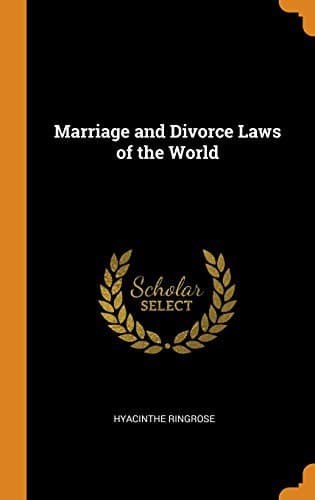
Marriage and Divorce Laws of the WorldRingrose, Hyacinthe
History
Marriage and Divorce Laws of the World
Ringrose, Hyacinthe
Divorce -- Law and legislation; Marriage law
The judicial system includes a Supreme Court of the Dominion, District
Courts and courts presided over by stipendiary magistrates.
MARRIAGE.--Males under fourteen years of age and females under twelve
years cannot contract a lawful marriage.
All persons, male or female, under twenty-one years of age, who have not
previously contracted a lawful marriage, require the consent of their
parents or guardians in order to marry. However, the marriage of males
fourteen years of age or more, or of females twelve years of age or more,
without the consent of parents or guardians, does not make such marriage
_ipso facto_ void.
Parental consent to a marriage of a minor must be given by the father, if
living and competent to act; if not, then by the following persons in the
order stated: (a) the duly appointed guardian; (b) the mother if she has
not married again; (c) or a guardian specially appointed by a court
exercising chancery powers.
No person can contract a new marriage who has a spouse by an existing
marriage still living.
CONSANGUINITY AND AFFINITY.--Marriage is forbidden between all ascendants
and descendants _ad infinitum_ and between persons related to each other
by blood or marriage within the third degree, according to the method of
computation of the civil law. According to this reckoning a person cannot
marry a relative nearer than his or her own first cousin.
PRELIMINARIES.--Notice of a proposed marriage must be given to the
registrar of the district in which one of the parties has resided for
three days at least. If the contracting parties live in different
districts notice must be given to the registrars of both districts. Such
notice must set forth the names, ages, status and occupations of each
party, together with their addresses, a statement of the period each party
has lived in the district, and the name and place of the church, chapel or
other building selected by the parties for the solemnization of the
marriage. The parties must also make solemn declaration to the registrar
or registrars to the truth of all statements of fact in said notice and
show that there is no legal impediment to the proposed marriage.
Upon receiving the notice in due form the registrar will issue a
certificate at once addressed to any officiating minister, or to himself,
authorizing the solemnization of the marriage. All marriages must be
registered, and the officiating minister or officer who fails to have the
record made is subject to punishment.
Ordinarily, the best proof of a marriage is to produce the marriage
certificate, together with proof identifying the parties, but if the
record is lost, destroyed or never existed proof of the marriage may be
given by direct oral evidence.
Public-domain text, read in full here on John Shaqi.
Reviews
Reviews
No reviews yet
Be the first to share your thoughts on this work.
Elsewhere in the archive
Join the Discussion
Join the discussion
Sign in to leave a comment or review.
Sign InorCreate an account