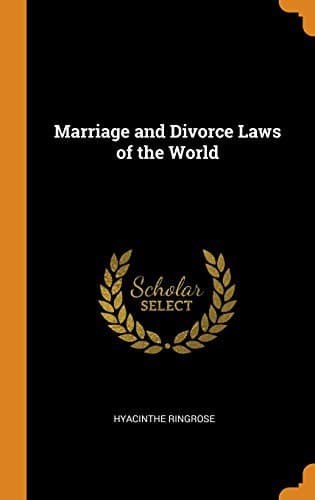
Marriage and Divorce Laws of the WorldRingrose, Hyacinthe
History
Marriage and Divorce Laws of the World
Ringrose, Hyacinthe
Divorce -- Law and legislation; Marriage law
The Vedas, upon which the whole structure of Hindu religion and ethics
professes to be based, give no countenance to the present regulations of
caste.
The Sanscrit word for caste is _verna_, meaning colour, and this leads us
to the true origin of caste distinctions. The _verna_, or colour, of the
light-complexioned Aryan invaders who entered India from the Northwest and
the _verna_ of the dark-skinned aborigines whom they subjugated
established the first distinctions of caste.
There are four principal castes to-day among the Hindus, namely:
1. _Brahmin_, or priest caste.
2. _Kshatriya_, or warrior caste.
3. _Vaisya_, or merchant caste.
4. _Sudra_, or servant caste.
A fifth class, called _Pariahs_, are of no caste, and are practically
outside the law.
The first three upper classes or castes are also called "twice-born" men,
because they are supposed to be regenerated or "born in the Veda."
So, generally, are the distinctions of caste recognized that Pope Gregory
XV. found it advisable to publish a bull sanctioning caste regulations in
the Christian churches of India.
The Hindus attach great importance to the marriage. It is regarded by them
as one of the ten _sankars_, or sacraments, necessary for the regeneration
of men of the twice-born classes, and the only sacrament for women and
_Sudras_.
The Veda says: "A Brahmin immediately upon being born is produced a debtor
in three obligations: to the holy saints for the practice of religious
duties; to the gods for the performance of sacrifice; to his forefathers
for offspring."
Manu ordains that "after a man has read the Vedas in the form prescribed
by law, has legally begotten a son and has performed sacrifices to the
best of his power, he has paid his three debts and may then apply his
heart to eternal bliss."
The Hindus hold the marriage relation in such respect that the question of
the validity of a marriage is rarely submitted to the courts for judicial
determination.
The law of the Catholic Church treats marriage as a sacramental contract
dissoluble only by death, but the Hindu law goes further by declaring
against the remarriage of widows.
This rule of Hindu has been legislated upon by Act XV. of 1856, which
makes a Hindu widow eligible for a new marriage, but the marriage of a
widow has never been the practice among Hindus.
Mann says: "A widow who from a wish to bear children slights her deceased
husband by marrying again brings a disgrace on herself here below and
shall be excluded from the seat of her lord."
Polygamy, or plurality of wives, is permitted by the Hindu law, but is
rarely practiced.
Polyandry, or plurality of husbands, is contrary both to the Hindu law and
the provisions of the Indian Penal Code.
The three higher castes are permitted to intermarry with the caste next
below their own, the issue taking the lower caste or sometimes forming a
new caste.
Public-domain text, read in full here on John Shaqi.
Reviews
Reviews
No reviews yet
Be the first to share your thoughts on this work.
Elsewhere in the archive
Join the Discussion
Join the discussion
Sign in to leave a comment or review.
Sign InorCreate an account