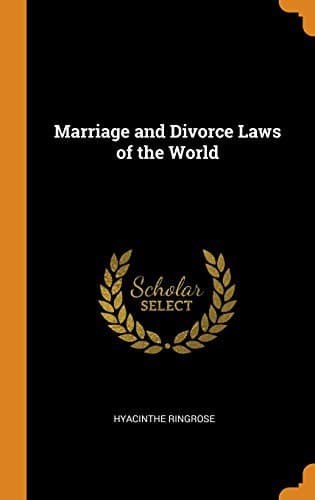
Marriage and Divorce Laws of the WorldRingrose, Hyacinthe
History
Marriage and Divorce Laws of the World
Ringrose, Hyacinthe
Divorce -- Law and legislation; Marriage law
DIVORCE.--As an institution divorce is almost as ancient in China as
marriage. Marriage is not considered as in any respect a religious
contract, but as a status created principally for the comfort of man and
the continuance of the race. As woman is considered an inferior creature
to man she has not the same rights in or out of a court of law. However,
she can obtain, against her husband's will, an absolute divorce on the
following grounds:
1. Impotency. If her husband is unable to perform the sexual act a wife
can compel him to grant her a deed of divorcement.
2. If a man sells his wife to another the woman is _ipso facto_ divorced
from both men.
3. If a man induces his wife to become a prostitute, or accepts her
earnings as such, the wife is entitled to a decree of absolute divorce.
We can find no other causes which entitle a woman to a divorce from her
husband. His adultery, cruelty, abandonment, neglect or drunkenness
furnishes no ground for a dissolution of the marriage.
For a husband divorce is very easy. The so-called "seven valid reasons"
enable any man so inclined to practically discard his wife when it pleases
him. The seven "reasons" or causes are:
1. Talkativeness.
2. Wantonness.
3. Theft.
4. Barrenness.
5. Disobedience to parents of husband.
6. Jealousy.
7. Inveterate infirmity.
The last of the seven reasons permits a man to get rid of a wife who is
incurably ill or infirm.
MUTUAL CONSENT.--If husband and wife mutually agree upon divorce the
courts, by ancient custom, will ratify their agreement. Although the
Chinese law does not consider the consent or non-consent of the parties as
of any consequence in creating the status of marriage, it, by a peculiar
process of logic, permits them to end the relationship whenever they
mutually please so to do.
Perhaps one can easier understand the marriage and divorce laws of the
Chinese Empire by remembering that all Chinese laws are supposed to follow
the instincts of the people (_Shun po hsing chi ching_).
GENERAL OBSERVATIONS.--The present laws and customs of China are but
little changed from the time of the Tang Dynasty, which reigned nearly
thirteen hundred years ago.
Then, as now, a poor man who finds himself unable to support his wife,
may, if she has no parents to take her back, sell her to his richer
neighbour.
The judicial machinery of the Chinese Empire is the elaboration of
centuries of customs and precedents. In the first instance parties seeking
legal redress apply by complaint to the lowest court having jurisdiction
within the district of their domicile. If dissatisfied with the decision
an appeal can be made first to the District Magistracy, then to the
Prefecture, and after that to the Supreme Provincial Court. If the
questions involved are sufficiently important a further appeal may be
prosecuted before the Judiciary Board, which sits in Peking and is the
highest judicial court in the Empire.
Public-domain text, read in full here on John Shaqi.
Reviews
Reviews
No reviews yet
Be the first to share your thoughts on this work.
Elsewhere in the archive
Join the Discussion
Join the discussion
Sign in to leave a comment or review.
Sign InorCreate an account