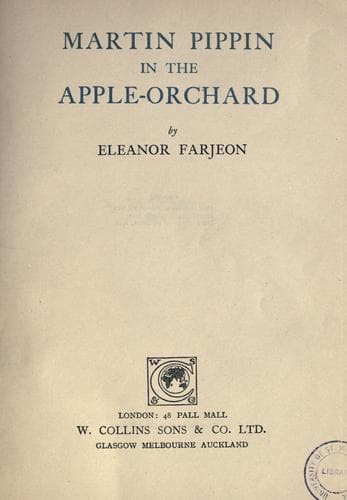
Martin Pippin in the Apple OrchardFarjeon, Eleanor
General
Martin Pippin in the Apple Orchard
Farjeon, Eleanor
Fairy tales; Minstrels -- Fiction
There were once, dear maidens, five lords in the east of Sussex, who
owned between them a single Burgh; for they were brothers. Their names
were Lionel and Hugh and Heriot and Ambrose and Hobb. Lionel was ten
years of age and Hobb was twenty-two, there being exactly three years
all but a month between the birthdays of the brothers. And Lionel had a
merry spirit, and Hugh great courage and daring, and Heriot had beauty
past any man's share, and Ambrose had a wise mind; but Hobb had nothing
at all for the world's praise, for he only had a loving heart, which he
spent upon his brothers and his garden. And since love begets love,
they all loved him dearly, and leaned heavily on his affection, though
neither they nor any man looked up to him because he was a lord.
Although he was the eldest, and in his quiet way administered the
affairs of the Burgh and of the people of Alfriston under the Burgh, it
was Ambrose who was always thinking of new schemes for improvement, and
Heriot who undertook the festivities. As for the younger boys, they
kept the old place alive with their youth and spirits; and it was
evident that later on Hugh would win honor to the Burgh in battle and
adventure, and Lionel would draw the world thither with his charm. But
Hobb, to whom they all brought their shapeless dreams white-hot, since
sympathy helps us to create bodies for the things which begin their
existence as souls--Hobb differed from the four others not only in his
name, but in his plain appearance and simple tastes. And all these
things, as well as his tender heart, he got from his mother, who was
the only daughter of a gardener of Alfriston. The gardener, to whom she
was the very apple of his eye, had kept her privately in a place on a
hill, fearing lest in her youth and inexperience she should fall to the
lot of some man not worthy of her; for her knew, or believed, that a
young girl of her sweetness and tenderness and devotedness of
disposition would by her sweetness attract a lover too early, and by
her tenderness respond to him too readily, and by her devotedness
follow him too blindly, before she had time to know herself or men. And
he also knew, or believed, that first love is as often a
will-o'-the-wisp as the star for which all young things take it. Five
days in the week he tended the gardens of Alfriston, the sixth he gave
to the Lord of the Burgh that lay among the hills, and the seventh he
kept for his daughter on the hill a few miles distant, which was
afterwards known as Hobb's Hawth. She on her part spent her week in
endeavoring to grow a perfect rose of a certain golden species, and her
heart was given wholly to her father and her flower. And he watched her
efforts with interest and advice, and for the first she thanked him but
of the second took no heed. "For," said she, "this is MY garden,
father, and MY rose, and I will grow it in my own way or not at all.
Have you not had a lifetime of gardens and roses which you have brought
Public-domain text, read in full here on John Shaqi.
Reviews
Reviews
No reviews yet
Be the first to share your thoughts on this work.
Elsewhere in the archive
Join the Discussion
Join the discussion
Sign in to leave a comment or review.
Sign InorCreate an account