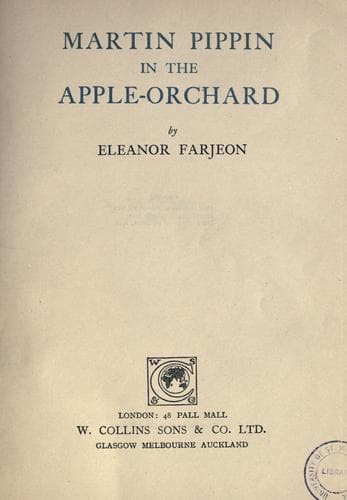
Martin Pippin in the Apple OrchardFarjeon, Eleanor
General
Martin Pippin in the Apple Orchard
Farjeon, Eleanor
Fairy tales; Minstrels -- Fiction
"Then here goes," said Martin, "and I only pray you to set your
sympathies also in motion while I endeavor to keep them going with the
story of Proud Rosalind and the Hart-Royal."
PROUD ROSALIND AND THE HART-ROYAL
There was once, dear maidens, a man-of-all-trades who lived by the
Ferry at Bury. And nobody knew where he came from. For the chief of his
trades he was an armorer, for it was in the far-away times when men
thought danger could only be faced and honor won in a case of steel;
not having learned that either against danger or for honor the naked
heart is the fittest wear. So this man, whose name was Harding, kept
his fires going for men's needs, and women's too; for besides making
and mending swords and knives and greaves for the one, he would also
make brooches and buckles and chains for the other; and tools for the
peasants. They sometimes called him the Red Smith. In person Harding
was ruddy, though his fairness differed from the fairness of the
natives, and his speech was not wholly their speech. He was a man of
mighty brawn and stature, his eyes gleamed like blue ice seen under a
fierce sun, the hair of his head and his beard glittered like red gold,
and the finer hair on his great arms and breast overlaid with an amber
sheen the red-bronze of his skin. He seemed a man made to move the
mountains of the world; yet truth to tell, he was a most indifferent
smith.
(Martin: Are you not quite comfortable, Mistress Jane?
Jane: I am perfectly comfortable, thank you, Master Pippin.
Martin: I fancied you were a trifle unsettled.
Jane: No, indeed. What would unsettle me?
Martin: I haven't the ghost of a notion.)
I have heard gossips tell, but it has since been forgotten or
discredited, that this part of the river was then known as Wayland's
Ferry; for this, it was said, was one of the several places in England
where the spirit lurked of Wayland the Smith, who was the cunningest
worker in metal ever told of in song or story, and he had come overseas
from the North where men worshiped him as a god. No one in Bury had
ever seen the shape of Wayland, but all believed in him devoutly, for
this was told of him, and truly: that any one coming to the ferry with
an unshod steed had only to lay a penny on the ground and cry aloud,
"Wayland Smith, shoe me my horse!" and so withdraw. And on coming again
he would find his horse shod with a craft unknown to human hands, and
his penny gone. And nobody thought of attributing to Harding the work
of Wayland, partly because no human smith would have worked for so mean
a fee as was accepted by the god, and chiefly because the quality of
the workmanship of the man and the god was as dissimilar as that of
clay and gold.
Public-domain text, read in full here on John Shaqi.
Reviews
Reviews
No reviews yet
Be the first to share your thoughts on this work.
Elsewhere in the archive
Join the Discussion
Join the discussion
Sign in to leave a comment or review.
Sign InorCreate an account