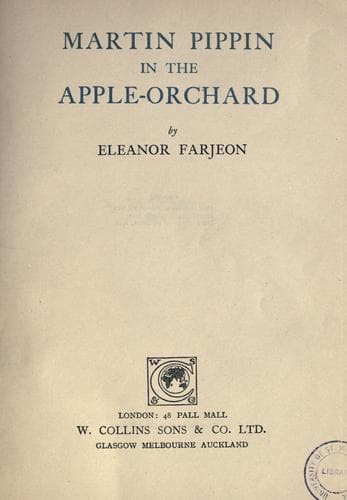
Martin Pippin in the Apple OrchardFarjeon, Eleanor
General
Martin Pippin in the Apple Orchard
Farjeon, Eleanor
Fairy tales; Minstrels -- Fiction
Now at the time when Harding first saw the calf, and the ruin of the
castle across the ferry was only a ruin, not fit for habitation, it was
nevertheless inhabited by the Proud Rosalind, who dwelt there without
kith or kin. And if time had crumbled the castle to its last nobility,
so that all that was strong and beautiful in it was preserved and, as
it were, exposed in nakedness to the eyes of men: so in her, who was
the ruins of her family, was preserved and exposed all that had been
most noble, strong and beautiful in her race. She was as poor as she
was friendless, but her pride outmatched both these things. So great
was her pride that she learned to endure shame for the sake of it. She
had a tall straight figure that was both strong and graceful, and she
carried herself like a tree. Her hair was neither bronze nor gold nor
copper, yet seemed to be an alloy of all the precious mines of the
turning year--the vigorous dusky gold of November elms, the rust of
dead bracken made living by heavy rains, the color of beechmast
drenched with sunlight after frost, and all the layers of glory on the
boughs before it fell, when it needed neither sun nor dew to make it
glow. All these could be seen in different lights upon her heavy hair,
which when unbound hung as low as her knees. Her thick brows were dark
gold, and her fearless eyes dark gray with gold gleams in them. They
may have been reflections from her lashes, or even from her skin, which
had upon it the bloom of a golden plum. Dim ages since her fathers had
been kings in Sussex; gradually their estate had diminished, but with
the lessening of their worldly possessions they burnished the brighter
the possession of their honor, and bred the care of it in their
children jealously. So it came to pass that Rosalind, who possessed
less than any serf or yeoman in the countryside, trod among these as
though she were a queen, dreaming of a degree which she had never
known, ignored or shrugged at by those whom she accounted her equals,
insulted or gibed at by those she thought her inferiors. For the
dwellers in the neighboring hamlets, to whom the story of her fathers'
fathers was only a legend, saw in her just a shabby girl, less worthy
than themselves because much poorer, whose pride and very beauty
aroused their mockery and wrath. They did not dispute her possession of
the castle. For what to them were four vast roofless walls, enclosing a
square of greensward underfoot and another of blue air overhead, and
pierced with doorless doorways and windowless casements that let in all
the lights of all the quarters of the sky? What to them were these
traces of old chambers etched on the surface of the old gray stone,
these fragments of lovely arches that were but channels for the winds?
In the thick of the great towered gateway one little room remained
above the arch, and here the maiden slept. And all her company was the
ghosts of her race. She saw them feasting in the halls of the air, and
Public-domain text, read in full here on John Shaqi.
Reviews
Reviews
No reviews yet
Be the first to share your thoughts on this work.
Elsewhere in the archive
Join the Discussion
Join the discussion
Sign in to leave a comment or review.
Sign InorCreate an account