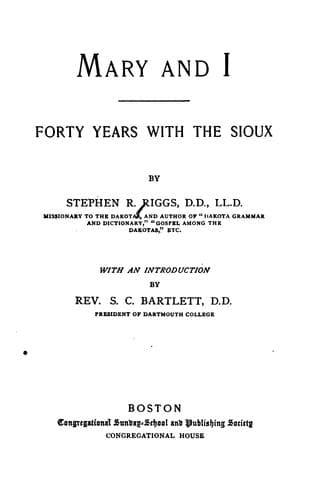
Mary and I: Forty Years with the SiouxRiggs, Stephen Return
History
Mary and I: Forty Years with the Sioux
Riggs, Stephen Return
Dakota Indians -- Missions; Riggs, Stephen Return, 1812-1883
Andrew Hunter drove one of his wagons around on the prairie to meet
our party as we emerged from the ravine, each carrying a little
bundle. The women and children who could not walk were arranged with
the bundles in the wagon. Mr. Cunningham was successful in getting one
of his horses--the other had been appropriated by an Indian, together
with mine. His one horse he attached to my buggy and brought it over
the river, and we proceeded to join the rest of Mr. Hunter's party.
Two or three families of government employés from the saw-mill had
found their way to our missionary company. Thus constituted, we
started for the old crossing of Hawk River, some six or eight miles
distant.
While we were still in sight of the river bluffs, we discovered a man
coming after us. He was evidently a white man, and hobbled along with
difficulty, as though he were wounded. We stopped until he overtook
us. It proved to be a man by the name of Orr, whose comrades had been
killed up near the mouth of the Chippewa, and he escaped in a crippled
condition. Our wagons were more than full, but we could make room for
a wounded white man. About this time a rain shower came upon us, which
was a Godsend in many ways, although it made camping that night rather
unpleasant.
When night overtook us, we were across the stream,--Hawk River,--and
we lay down to rest and consider what should be our course on the
morrow. In the morning, we had decided to cross the country, or
endeavor to do so, toward Hutchinson or Glencoe. But the country was
not familiar to us. We frequently found ourselves stopped in our
course by a slough which was not easy to cross. Still, we kept on our
way during Wednesday, and in the afternoon there fell to us four men
from Otherday's party. These men all had guns which were not of much
account. They belonged at New Ulm, and did not want to go to
Hutchinson. But they continued with us that day.
The evening came with a slow continued rain. The first night we were
out, the smaller children had cried for home. The second night, some
of the older children would have cried if it had been of any use. We
had no shelter. The wagons were no protection against the continued
rain, but it was rather natural to crawl under them. The drop, _drop_,
DROP, all night long from the wagon-beds, on the women and children,
who had not more than half covering in that cold August rain, was not
promotive of cheerfulness. Mrs. Moore looked sad and disheartened, and
to my question as to how she did she replied that one might as well
die as live under such circumstances.
Public-domain text, read in full here on John Shaqi.
Reviews
Reviews
No reviews yet
Be the first to share your thoughts on this work.
Elsewhere in the archive
Join the Discussion
Join the discussion
Sign in to leave a comment or review.
Sign InorCreate an account