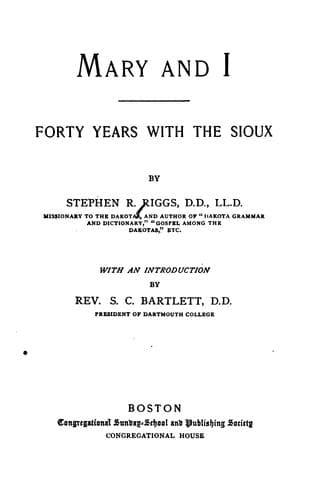
Mary and I: Forty Years with the SiouxRiggs, Stephen Return
History
Mary and I: Forty Years with the Sioux
Riggs, Stephen Return
Dakota Indians -- Missions; Riggs, Stephen Return, 1812-1883
When Mary and the children had safely reached friends and civilization
at Mr. Pond's, I was pressed in spirit with the thought that I might
have some duty to perform in the Indian country. At Lac-qui-parle,
twenty-five miles beyond our station at Hazelwood, were Amos W.
Huggins, with wife and children, and Miss Julia La Framboise. They had
been in the employ of the government as teachers at Wakanmane's
village. What had befallen them, we knew not; but we knew that white
men had been killed between our place and Lac-qui-parle. Then, our
native church members--they might need help. And so I took a boat at
Shakopee, and went down to St. Paul, and offered my services to
Governor Ramsay, in whatever capacity he chose to put me. He
immediately commissioned me as chaplain to General Sibley's
expedition. The last day of August I was at St. Peter, where I learned
from Mr. Huggins' friends the story that he had been killed, and that
his wife and children were captives. In regard to them I received a
special charge from Mrs. Holtsclaw, and I conceived a plan of
immediately sending for Mrs. Huggins. But circumstances made it
impossible to carry out that plan for several weeks.
The next day, Sabbath though it was, I rode up with Colonel Marshall
and others to Fort Ridgely, where General Sibley's command was
encamped. He was waiting for reinforcements and ammunition supplies.
At the first news of the massacres, a large number of citizens had
impressed their neighbors' horses, and had started for the Indian
country. Many of them were poor riders, and they were all poorly
armed. They were without military organization and drill, and were
felt to be an element of weakness rather than strength. A night or two
before I reached the camp, a couple of shots had been fired, supposed
to have been by Indians. The drum beat the "long roll," and the men
that formed this "string-bean cavalry," as they were called, crawled
under the wagons. The next morning many of them had had a clairvoyant
communication with their families at home, and learned that their
wives were sick. They were permitted to depart.
Public-domain text, read in full here on John Shaqi.
Reviews
Reviews
No reviews yet
Be the first to share your thoughts on this work.
Elsewhere in the archive
Join the Discussion
Join the discussion
Sign in to leave a comment or review.
Sign InorCreate an account