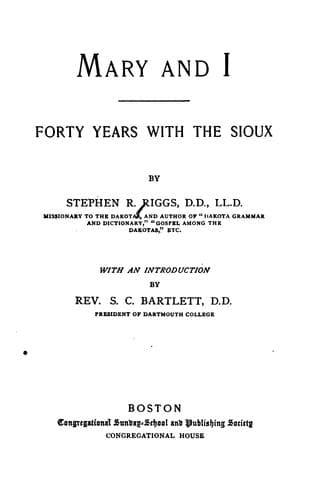
Mary and I: Forty Years with the SiouxRiggs, Stephen Return
History
Mary and I: Forty Years with the Sioux
Riggs, Stephen Return
Dakota Indians -- Missions; Riggs, Stephen Return, 1812-1883
Thus the Indians were beaten and retired. During the fight John
Otherday captured a Dakota pony, and so made good the loss of his
stolen horse. Simon Anawangmane was wounded in the foot in passing out
to the hostile Sioux and back to our camp; and the younger Simon was
brought in wounded, and died some days afterward. The day following
this battle, our camp was removed to a point beyond the mission
station at Hazelwood. As I rode down to see the ruins of our
buildings, some of our soldiers were emptying a _cache_ near where our
house had stood. The books they threw out I found were from my own
library. A part of these and some other things which were in good
condition I secured. They had been buried by our friends.
The next day was the 26th of September, when we pushed on to Camp
Release, where the friendly Dakotas were encamped. The hostiles and
such as feared to remain had fled to the British Possessions. The
friendly Indians had by some means come into the possession of almost
all the captive white women and children. One of our chief objects in
pursuing the campaign had been to prevent the killing of these
captives. Little Crow had written to General Sibley that he had many
captives; and General Sibley had replied, "I want the captives."
Now they came into our hands, nearly a hundred, besides half-breeds,
many of whom had been in a kind of captivity. The white women had
dressed up as well as they could for the occasion, but many of them
only showed their white relationship by the face and hands and
hair--they were dressed like Indians. It was a time of gladness for
us. White men stood and cried for joy. We took them all to our camp,
and wrapped them up as well as we could. Some of the women complained
because we did not furnish women's clothing; but that was
unreasonable. This was _Camp Release_.
Mr. Amos W. Huggins was the eldest child of Alexander G. Huggins, who
had accompanied Dr. Williamson to the Sioux country in 1835. Amos was
born in Ohio, and was at this time over thirty years old. He was
married, and two children blessed their home, which, for some time
before the outbreak, had been at Lac-qui-parle, near where the town of
that name now stands. It was then an Indian village and planting
place, the principal man being Wakanmane,--Spirit Walker, or Walking
Spirit. If the people of the village had been at home, Mr. Huggins and
his family, which included Miss Julia La Framboise, who was also a
teacher in the employ of the government, would have been safe. But in
the absence of Spirit Walker's people three Indian men came--two of
them from the Lower Sioux Agency--and killed Mr. Huggins, and took
from the house such things as they wanted.
Public-domain text, read in full here on John Shaqi.
Reviews
Reviews
No reviews yet
Be the first to share your thoughts on this work.
Elsewhere in the archive
Join the Discussion
Join the discussion
Sign in to leave a comment or review.
Sign InorCreate an account