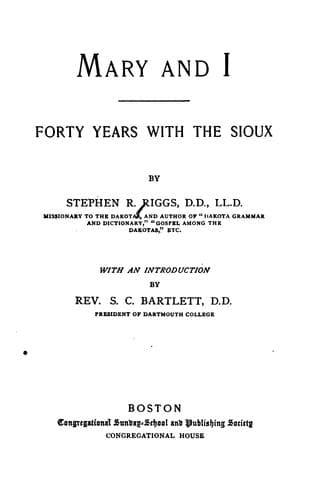
Mary and I: Forty Years with the SiouxRiggs, Stephen Return
History
Mary and I: Forty Years with the Sioux
Riggs, Stephen Return
Dakota Indians -- Missions; Riggs, Stephen Return, 1812-1883
All along the line of the frontier, where the Sioux raids had been
made, were many families who had returned to desolated homes. Many
persons all over the country took a deep interest in this class of
sufferers, and money contributions were made for their relief. The
Friends in Indiana and elsewhere had placed their contributions in the
hands of Friend W. W. Wales of St. Anthony. Here was a service in
which I could engage, and find relief from the strain of the campaign
and the condemnations. Accordingly, I undertook to hunt up needy
families in the neighborhood of Glencoe and Hutchinson, and to
dispense a few hundred dollars of this benevolent fund. One day, as I
was traveling in my one-horse buggy over the snow between Glencoe and
Hutchinson, I was overtaken by a messenger from General Sibley, asking
me to report to Colonel Miller, who was in command of the prison at
Mankato, to be present and give assistance at the time of the
executions.
As a matter of duty, I obeyed. From my youth up, it had been a
determination of mine never to go to see a fellow-being hanged. No
curiosity could have taken me. Rather would I have gone the other way.
But, if I could be of service to Indian or white man, in preventing
mistakes and furthering the ends of justice and righteousness, my own
feelings should be held in abeyance and made to work in the line of
duty.
On receiving the papers transmitted from the military commission,
President Lincoln had placed them in the hands of impartial men, with
instructions to report the cases which, according to the testimony,
were convicted of participation in individual murders or in violating
white women. Acting under these instructions, thirty-nine cases were
reported, and these were ordered by the President to be executed. But
among so many it was a matter of much difficulty to identify all the
cases. Among the condemned there were several persons of the same
name--three or four _Chaskays_, two or three _Washechoons_. In the
findings of the commission they were all numbered, and the order for
the executions was given in accordance with these numbers. But no one
could remember which number attached to which person. The only certain
way of avoiding mistakes was by examining closely the individual
charges. To Joseph R. Brown, who better than any other man knew all
these condemned men,--and he did not recognize all perfectly,--was
mainly committed the work of selecting those who were named to be
executed. Extraordinary care was meant to be used; but after it was
all over, when we came to compare their own stories and confessions,
made a day or two before their death, with the papers of condemnation,
the conviction was forced upon us that two mistakes had occurred.
Public-domain text, read in full here on John Shaqi.
Reviews
Reviews
No reviews yet
Be the first to share your thoughts on this work.
Elsewhere in the archive
Join the Discussion
Join the discussion
Sign in to leave a comment or review.
Sign InorCreate an account