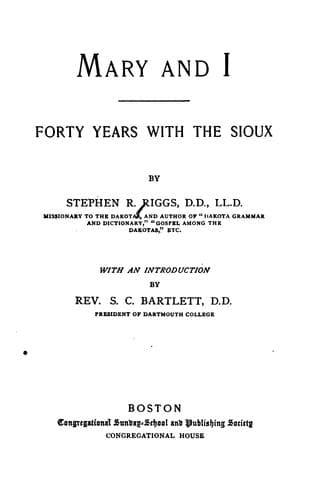
Mary and I: Forty Years with the SiouxRiggs, Stephen Return
History
Mary and I: Forty Years with the Sioux
Riggs, Stephen Return
Dakota Indians -- Missions; Riggs, Stephen Return, 1812-1883
"The _suspense_ was terrible. The ignorant women had not seen much of
the world, and didn't know anything about law. They, however, knew
that their husbands and sons had been murdering the whites, and were
now in prison therefor, and they themselves dependent for life on the
mercy of the whites. The ever-present query was, What will become of
us, and especially of the men? With inquisitive eyes they were always
watching the soldiers and other whites who visited them, for an
answer, but the curses and threats they received were little
understood, except that they meant no good. With what imploring looks
have we been besought to tell them their fate. Strange reports were
constantly being whispered around the camp. Now, the men were all to
be executed, of whom the thirty-eight hanged at Mankato was the first
installment, and the women and children scattered and made slaves;
now, they were all to be taken to a rocky barren island somewhere, and
left with nothing but fish for a support; and, again, they were to be
taken away down South, where it was so hot they would all die of fever
and ague."
Rev. John P. Williamson, having been providentially absent in Ohio at
the time of the outbreak, returned to accompany this camp of despised
and hated Dakotas in their journey from the Lower Sioux Agency to Fort
Snelling. But it did not immediately appear what he could do for them.
He and I were in much the same condition, looking around for other
work. He says of himself that at this time he "made some effort to
secure a place as stated supply in the neighborhood of St. Paul or
Minneapolis, but was unsuccessful; and then he felt such drawing
toward the Indian camp that he took the nearest available quarters,
and spent the winter ministering temporally and spiritually to this
afflicted people."
When, in the spring following, they were taken down the Mississippi
and up the Missouri to Crow Creek, he did not forsake them, but stayed
by them in evil and in good report, with the devotion of a lover.
Everywhere, and at all times his thoroughly honest, devoted, and
unselfish course commanded the respect and confidence of white men in
and out of the army. And his self-abandonment to the temporal and
spiritual good of the families of the men in prison begot in them such
admiration and confidence that scarcely a prayer was made by them, in
all those four years of their imprisonment, without the petition that
God would remember and bless "the one who is called John."
The camp at Snelling was on the low ground near the river, where the
steamboats were accustomed to land. A high board fence was made
around two or three acres of ground, inside of which the Dakotas
pitched their cloth tents. In them they cooked and ate and slept, and
read the Bible and sang and prayed, and wrote letters to their friends
in prison.
Public-domain text, read in full here on John Shaqi.
Reviews
Reviews
No reviews yet
Be the first to share your thoughts on this work.
Elsewhere in the archive
Join the Discussion
Join the discussion
Sign in to leave a comment or review.
Sign InorCreate an account