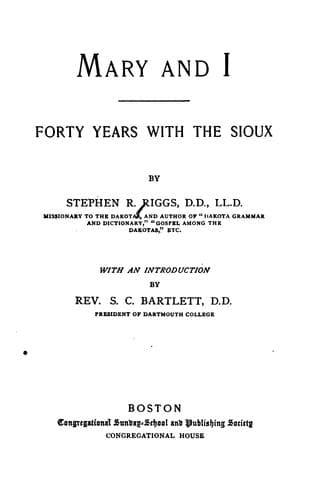
Mary and I: Forty Years with the SiouxRiggs, Stephen Return
History
Mary and I: Forty Years with the Sioux
Riggs, Stephen Return
Dakota Indians -- Missions; Riggs, Stephen Return, 1812-1883
After a little while, their irons were all taken off, and they enjoyed
comparative liberty, being often permitted to go to the town to trade
their bows and arrows and other trinkets, and sometimes into the
country around to labor, without a guard. They never attempted to make
their escape, though at one time it was meditated by some, but so
strongly and wisely opposed by the more considerate ones, that the
plan was at once abandoned. Generally the soldiers who guarded them
treated them kindly. It was remarked that a new company, whether of
the regular army or of volunteers, when assigned to this duty, at the
first treated the prisoners with a good deal of severity and
harshness. But a few weeks sufficed to change their feelings, and they
were led to pity, and then to respect, those whom they had regarded as
worse than wild beasts.
The camp was not a pleasant place, except in summer. The surroundings
were rather beautiful. The oak groves of the hill-side which bordered
the river were attractive. And the buildings occupied by the troops
were comfortable. But within the stockade, where the prisoners were
kept, the houses were of the most temporary kind, through the
innumerable crevices of which blew the winter winds and storms. Only a
limited amount of wood was furnished them, which, in the cold windy
weather, was often consumed by noon. Then the Indians were under the
necessity of keeping warm, if they could, in the straw and under their
worn blankets.
In these circumstances, many would naturally fall sick go into a
decline,--pulmonary consumption, for which their scrofulous bodies had
a liking,--and die. The hospital was generally well filled with such
cases. The death-rate was very large--more than ten per cent. each
year, making about 120 deaths while they were confined at that place.
About one hundred men, women, and children, who came afterward into
the hands of the military, were added to those who were first brought
down. These latter were uncondemned. As some, women had been permitted
to come with the prisoners at the first, and now more were added, a
good many children were born there. And thus it came to pass that all
who were released and returned to their people from this prison
numbered only about two hundred and fourscore.
For the first two years of their abode at Davenport, Dr. Williamson
had the chief care of the educational and church work among them.
During this time I only visited them twice. Once, when a difficulty
and misunderstanding had arisen between Dr. Williamson and a General
Roberts, who at one time commanded that department, the doctor was
obliged to return to his home in St. Peter. On learning the fact, I
counselled with General Sibley, who gave me a letter to General
Roberts. Before I reached there, however, Roberts had become ashamed
of his conduct, as I judged, and so I found it quite easy to restore
amicable relations. No such difficulties occurred thereafter.
Public-domain text, read in full here on John Shaqi.
Reviews
Reviews
No reviews yet
Be the first to share your thoughts on this work.
Elsewhere in the archive
Join the Discussion
Join the discussion
Sign in to leave a comment or review.
Sign InorCreate an account