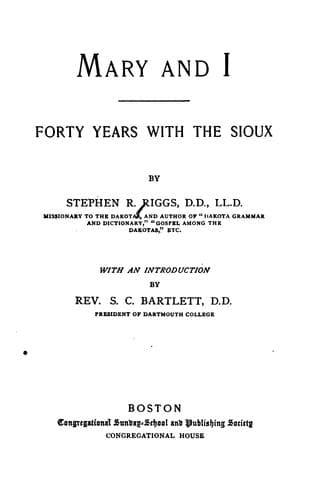
Mary and I: Forty Years with the SiouxRiggs, Stephen Return
History
Mary and I: Forty Years with the Sioux
Riggs, Stephen Return
Dakota Indians -- Missions; Riggs, Stephen Return, 1812-1883
"When the number of our years got well past the single figures, then
we went to 'the States,' to carry on the education begun at home. Then
came the saddest disappointment of all our lives. We found we were yet
a good way from heaven. For me, the last remnant of this dream was
effectually dispelled when I came to teach a Sabbath-school in a back
country-neighborhood, where the people were the drift-wood of Kentucky
and Egyptian Illinois. Thenceforth the land of the Dakotas seemed more
the land of promise to me. From that time the claims of the work in
which my parents were engaged grew upon my mind.
"Of late years the children of missionaries have everywhere furnished
a large portion of the new reinforcements. This is both natural and
strange. It is natural that they should desire to stay the hands of
their parents, and go to reap what they have sown. On the other hand,
they go out in face of all the hardships of the work, made vividly
real to them by the experience of their childhood. They are attracted
by no romantic sentiment. The romance is for them all worn off long
ago. For instance, those of us on this field know the noble red man of
the poet to be a myth. We know the real savage, and know him almost
too well. Thus those who follow in the work of their missionary
fathers do not do it without a struggle--often fearful. On the one
hand stands the work, calling them to lonesome separation, and on the
other the pleasant companionship of civilized society. But if the word
of the Lord has come to them to go to Nineveh, happy are they if they
do not go thither by way of Joppa.
"I have spoken of the drawbacks to entering the work, but the
inducements must also be remembered. They are greater than the
drawbacks. We know them also better than strangers can. If we have
known more of the discouragements of the work, we also know more of
its hopefulness. We know the real savage, but we now know and fully
believe in his real humanity and salvability by the power of the
cross. Now, too, when the work is entered, the very difficulties which
barred the way grow less or disappear. We find the dreaded isolation
to be more in appearance than reality. We here are in connection with
the best thought and sympathy of the civilized world, whether it be in
scholarship, statesmanship, or Christian society. And not unfrequently
do we have the visits of friends and the honored representatives of
the churches. One may be much more alone in Chicago or New York.
Public-domain text, read in full here on John Shaqi.
Reviews
Reviews
No reviews yet
Be the first to share your thoughts on this work.
Elsewhere in the archive
Join the Discussion
Join the discussion
Sign in to leave a comment or review.
Sign InorCreate an account