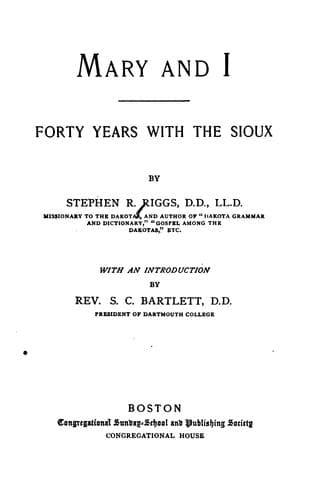
Mary and I: Forty Years with the SiouxRiggs, Stephen Return
History
Mary and I: Forty Years with the Sioux
Riggs, Stephen Return
Dakota Indians -- Missions; Riggs, Stephen Return, 1812-1883
In the latter end of August there came to me a letter, written in a
strange hand, saying that Anna was lying sick at Mr. Carr's, of
typhoid fever. The intention of the letter evidently was not to
greatly alarm me, but it conveyed the idea that she was very sick, and
the result was doubtful. Ten or twelve days had passed since it was
written. My affairs were not then in a condition to be left without
much damage, and so I determined to await the coming of another mail.
When I heard again, a week later, there was no decided change for the
better. So the letter read. But in the meantime this word had come to
me--"This sickness is not unto death, but for the glory of God." It
came to me like a revelation. I seemed to know it. It quieted my
alarm. All anxiety was not taken away, but my days passed in
comparatively quiet trust. About the middle of September I started
down with my own team, and, on reaching St. Peter and Mankato, I
received letters from Anna written with her own hand. She had come up
gradually, but a couple of months passed before she was strong.
Before I commenced building at Good Will, which was the name we gave
to our new station, the understanding was that Anna would be married
in the coming autumn, and she and her husband would take charge of the
mission work there. Anna seemed to have grown up into the idea that
her life-work was to be with the Dakotas. But it was otherwise
ordered. In the October following, when we all again met in Beloit,
she was married to H. E. Warner, who had lost an arm in the War of
the Rebellion, and they have since made their home in Iowa.
Martha Taylor Riggs had been married to Wyllys K. Morris, in December,
1866. For a time they made their home in Mankato, Minn., and then
removed to a farm twenty miles from town. Life on the extreme frontier
they found filled with privations and hardships, and so were quite
willing to accept the new place; and before the winter set in they
were removed to Good Will. Robert, who had gone up after his mother's
death, and spent a year with Martha at Sterling, Minn., returned to
Beloit, and entered the preparatory department of the college.
Cornelia went with us to Good Will, and remained two years.
* * * * *
The home was again in Dakota land. We at once opened a school, which
has since been taught almost entirely by W. K. Morris.[6] The native
churches needed a good deal of attention. At Lac-qui-parle a number of
families had stopped and taken claims. There a church was organized of
about forty members, which for two or three years was in the charge of
Rev. John B. Renville. But about this time Mr. Renville removed to the
reservation, and from that time the Dakota settlement gradually
diminished, until all had removed, and the Lac-qui-parle church was
absorbed by those on the reserve.
[6] This school has been much enlarged since 1877.
Public-domain text, read in full here on John Shaqi.
Reviews
Reviews
No reviews yet
Be the first to share your thoughts on this work.
Elsewhere in the archive
Join the Discussion
Join the discussion
Sign in to leave a comment or review.
Sign InorCreate an account