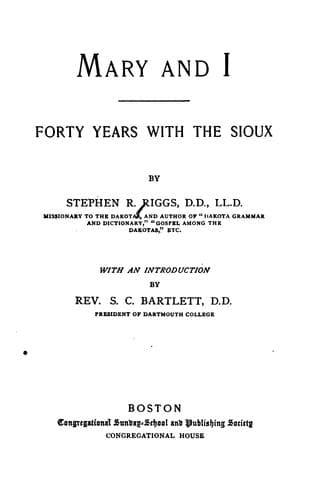
Mary and I: Forty Years with the SiouxRiggs, Stephen Return
History
Mary and I: Forty Years with the Sioux
Riggs, Stephen Return
Dakota Indians -- Missions; Riggs, Stephen Return, 1812-1883
"The annual meeting of the Dakota Mission was held at Yankton agency,
commencing June 13. We esteem it a rare privilege to have been present
on that occasion and to have seen with our own eyes the marvelous
transformations wrought by the Gospel among this people. Thirty-six
hours by rail took us to Yankton, the border town of civilization.
Twelve hours more in stage and open wagon along the north bank of the
Missouri--the Big Muddy, as the Indians rightly call it--carried us
sixty miles into the edge of the vast open prairie, and into the heart
of the Yankton reservation. Here, scattered up and down the river
bottom for thirty miles, live the Yanktons, one of the Dakota bands,
about 2000 in number. Thirty miles below, on the opposite bank, in
Nebraska, are the Santees. Up the river for many hundreds of miles at
different points other reservations are set off, while several wilder
bands still hunt the buffalo on the wide plains that stretch westward
to the Black Hills. The Sissetons, another family of this tribe, are
located near Lake Traverse, on the eastern boundary of Dakota
Territory. This is the field of the Dakota Mission. The chief bands
laid hold of thus far are the Sisseton, the Santee, and the Yankton. A
new point has recently been taken at Fort Sully, among the Teetons.
"It was from these places, lying apart in their extremes at least 300
miles, that more than a hundred Indians gathered at this annual
meeting. On Thursday afternoon the hospitable doors of Rev. J. P.
Williamson's spacious log house opened just in time to give us shelter
from a fierce storm of wind and rain. The next morning the Santees,
fifty of them from the Pilgrim Church, some on foot, some on
pony-back, and a few in wagons, straggled in, and pitched their camp,
in Indian fashion, on the open space near the mission house. About
noon the Sissetons appeared, a dilapidated crowd of more than forty,
weary and foot-sore with their 300 miles tramp through ten tedious
days. Among them was one white person, a woman, with her two children,
the youngest an infant, not a captive, but a missionary's wife,
traveling thus among a people whom the Gospel had made captives
themselves, chiefly through the labors of an honored father and a
mother of blessed memory. It intimates the courage and endurance
needed for such a trip to know that there were almost no human
habitations on the way, and that swollen rivers were repeatedly
crossed in the wagon-box, stripped of its wheels and made sea-worthy
by canvas swathed underneath.
"An hour afterward, from 200 miles in the opposite direction, the Fort
Sully delegation appeared. For Father Riggs, and the younger son,
famous as a hard rider, this journey was no great affair. But the
tenderly reared young wife--how she could endure the five days of
wagon and tent life is among the mysteries.
Public-domain text, read in full here on John Shaqi.
Reviews
Reviews
No reviews yet
Be the first to share your thoughts on this work.
Elsewhere in the archive
Join the Discussion
Join the discussion
Sign in to leave a comment or review.
Sign InorCreate an account