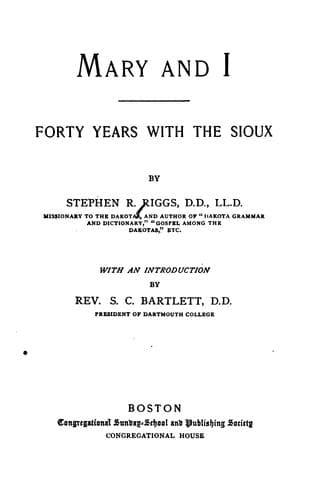
Mary and I: Forty Years with the SiouxRiggs, Stephen Return
History
Mary and I: Forty Years with the Sioux
Riggs, Stephen Return
Dakota Indians -- Missions; Riggs, Stephen Return, 1812-1883
This made it possible for all the churches on the Sisseton reservation
to be represented by pastors and elders. A. L. Riggs brought over a
good delegation from the Santee, so that we had there seventeen of our
most prominent men. The present missionaries and assistant
missionaries of the Board, except Mr. and Mrs. Morris, were all there.
Our brother John P. Williamson was engaged in church-building, and
could not attend. But there were the Pond brothers and Dr. T. S.
Williamson accepting with glad hearts the results of their labors
commenced thirty-nine years before. And the presence of so large an
Indian delegation added much to the popular interest of the occasion.
So that the subject of Indian missions in general, and of the Dakota
mission in particular, engaged the attention of this great meeting for
about one-third of their time. Artemas Ehnamane, the pastor of Pilgrim
Church at Santee, and Paul Mazakootemane, the hero of the outbreak of
1862, both made addresses before the Board, which were interpreted by
A. L. Riggs.
In the Dakota _Word Carrier_, we were at this time publishing a series
of "Sketches of the Dakota Mission," which we gathered into a pamphlet
and distributed to the thousands of Christian friends gathered there.
Number twelve of these sketches is mainly a contrast between the
commencement and the present state of our work among the Dakotas, from
which I make the following extract:--
"THEN AND NOW.
"In the first days of July, 1839, a severe battle was fought between
the Dakotas and Ojibwas. The Ojibwas had visited Fort Snelling during
the last days of June, expecting to receive some payment for land
sold. In this they were disappointed. The evening before they started
for their homes--a part going up the Mississippi, and a part by the
St. Croix--two young men were observed to go to the soldiers'
burying-ground, near the fort, and cry. Their father had been killed
some years before by the Dakotas, and was buried there. The next
morning they started for their homes; but these two young men, their
people not knowing it, went out and hid themselves that night close by
a path which wound around the shores of Lake Harriet. In the early
morning following, a Dakota hunter walked along that path, followed by
a boy. The man was shot down, and the boy escaped to tell the story.
"During their stay in the neighborhood of Fort Snelling, the Ojibwas
had smoked and eaten with the Dakotas. That scalped man now lying by
Lake Harriet was an evidence of violated faith. The Dakotas were eager
to take advantage of the affront. The cry was for vengeance; and
before the sun had set, two parties were on the war-path.
Public-domain text, read in full here on John Shaqi.
Reviews
Reviews
No reviews yet
Be the first to share your thoughts on this work.
Elsewhere in the archive
Join the Discussion
Join the discussion
Sign in to leave a comment or review.
Sign InorCreate an account