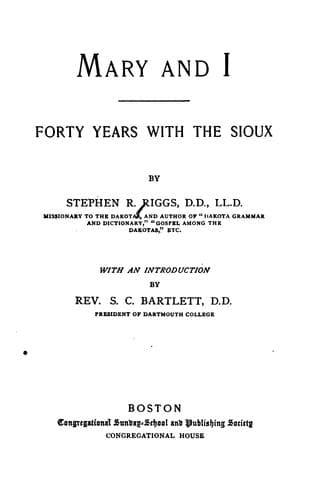
Mary and I: Forty Years with the SiouxRiggs, Stephen Return
History
Mary and I: Forty Years with the Sioux
Riggs, Stephen Return
Dakota Indians -- Missions; Riggs, Stephen Return, 1812-1883
Very soon after reaching Bayfield, we found a boat going over to
Odanah, which, I understand, is the Ojibwa for town or village, and
which is the name by which the mission station on Bad River has long
been known. As I entered the boat, Mr. Wheeler introduced me to the
Ojibwa men who were to take us over. When I shook hands with one of
them, he said, "My father, Mr. Riggs." Was he calling me his father,
or was it the Indian? I wondered which, but asked no questions. Two or
three days after, I learned that adoption was one of the Ojibwa
customs, and that when Mr. Wheeler was a little boy this man lost his
boy. He came to the mission and said to the missionary, "My boy is
gone; you have a great many boys; let me call this one mine." And so
they said he might so call him; and from that time Edward Payson
Wheeler became the adopted child of an Ojibwa.
Now, after he had been gone ten years, going away a boy and coming
back a man, they all seemed to regard him like a son and a brother. It
was very interesting for me to see how they all warmed toward him.
They came to see him, and wanted him to go to their houses. They all
wanted to talk with him; and when we came to leave, they all flocked
to the mission to shake hands, and to have a last word and a prayer;
and they gave him more _muckoks_ of _manomin_ (wild rice) than he
could bring away with him.
For four days we were the guests of the boarding-school which is in
charge of Rev. Isaac Baird. We became much interested in the school
and the teachers--Mrs. Baird, Miss Harriet Newell Phillips, Miss
Verbeek, Miss Dougherty, and Miss Walker. Naturally, I should be
prejudiced in favor of the Dakotas, but I was obliged to confess that
I had not seen anywhere twenty-five boys and girls better-looking and
more manly and womanly in their appearance than those Ojibwas. The
whole community gave evidence of the good work done by the school in
past years--many of the grown folks being able to talk English quite
well.
But there was one impression that came to me without bidding--it was
that civilization had been pressed farther and faster than
evangelization. While houses and other improvements attested a great
deal of labor expended, the native church is quite small, only now
numbering about twenty-eight, and the _metawa_, their sacred heathen
dance, was danced while we were there, within a stone's-throw of the
church. My spirit was stirred within me, and I said to the members of
that native church that they ought so to take up the work of
evangelizing their own people in good earnest that the dancing of the
_metawa_ thus publicly would become an impossibility.
Public-domain text, read in full here on John Shaqi.
Reviews
Reviews
No reviews yet
Be the first to share your thoughts on this work.
Elsewhere in the archive
Join the Discussion
Join the discussion
Sign in to leave a comment or review.
Sign InorCreate an account