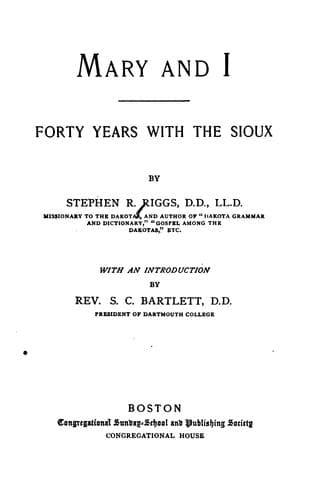
Mary and I: Forty Years with the SiouxRiggs, Stephen Return
History
Mary and I: Forty Years with the Sioux
Riggs, Stephen Return
Dakota Indians -- Missions; Riggs, Stephen Return, 1812-1883
Our Conference meetings began on the afternoon of Thursday, Sept. 16,
and by that time we were all on the ground and ready. We had
journeyed, camping by the way, some over from the Missouri and others
down from the head of the Coteau. The native delegates and visitors
were encamped by the river-side, convenient to wood and water and the
place of meeting. The missionaries pitched their tents by the house
and enjoyed the hospitality of P. A. Vannice and his good wife.
At the time appointed we gathered at the church and had a sermon by
one of the native pastors--Louis. Then came the business organization,
followed by short speeches of greeting and welcome. On the following
day the real work of the Conference began. Questions relating to the
proper training and education of children, and the training and
preparation needful for the ministry, were discussed with interest and
profit. The next day, which was Saturday, was taken up in the
discussion of two prominent subjects of interest--the homestead act in
its relation to Indians, and our Dakota paper. On the first of these
topics there was a full and healthy expression of opinion. It was said
that the plan of depending on the government for support tended to
bad. Said Ehnamane: "If when we are hungry we cry out to our Great
Father 'Give us food,' or when we are cold we say, 'Send us clothes,'
we become as little children--we are not men. Here at this place we
see that each man takes care of himself; he has a farm and a house,
and some have a cow and a few chickens. We go into their houses and
we see tables and chairs, and when they eat they spread a cloth over
the table, as do white people, and there are curtains to the windows,
and we see the women dressed like white women--here we find men. We
who look to the government for food and clothing are not men but
little children, and the longer we depend on the government the lower
down we find ourselves." Others differed: they said one could grow
into manhood anywhere supported by the government or caring for
themselves. Besides, it would not do to be too confident. It was hard
work to strike out alone; some had starved, some had been frozen to
death, and others had turned back. It means _work_ to become a
self-supporting citizen.
Perhaps there was as much real feeling expressed when the _Iapi Oaye_
was discussed as at any other time during Conference. Last year it was
hoped that by another year the paper would become self-sustaining.
Owing to several reasons, however, the subscription receipts for the
past year are very much smaller than for the year previous,
necessitating the meeting of a considerable deficiency by the
missionaries themselves. It was thought best for our native membership
to know the facts in order to stimulate action, lest we be obliged to
discontinue the paper. However, they would listen to nothing of that
kind.
Public-domain text, read in full here on John Shaqi.
Reviews
Reviews
No reviews yet
Be the first to share your thoughts on this work.
Elsewhere in the archive
Join the Discussion
Join the discussion
Sign in to leave a comment or review.
Sign InorCreate an account