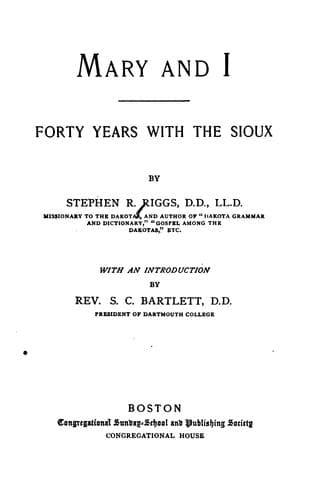
Mary and I: Forty Years with the SiouxRiggs, Stephen Return
History
Mary and I: Forty Years with the Sioux
Riggs, Stephen Return
Dakota Indians -- Missions; Riggs, Stephen Return, 1812-1883
Thomas Lawrence was Mary's second boy. He could hardly be reconciled
with the idea that his mother should go away to the spirit land, while
he was down in Mississippi teaching the freedmen. Now he had been two
years in Chicago Theological Seminary, and was asking what he should
do when the other year was finished. The Prudential Committee of the
American Board were looking around for some one to send to the Upper
Missouri. Thomas had been born and brought up, in good part, in the
land of the Dakotas; but they deemed it only fair that he should now
with a man's eyes see the field, and with a man's heart better
understand the work before committing himself to it. And so, in his
summer vacation of 1871, they said to him, "Go with your father to the
land of the Teetons, and see whether you can find your life-work with
them."
We came to the land of the Teetons, and stopped for five or six weeks
at Fort Sully, which was in the neighborhood of Cheyenne agency. There
we found Chaplain G. D. Crocker, who had been much interested in our
work among the Dakotas when stationed at Fort Wadsworth. We found also
good and true Christian friends in Captain Irvine and his wife, and in
the noble Mrs. General Stanley, the wife of the commandant of the
post. In the mornings of our stay in the garrison, we often gathered
buffalo berries--mashtinpoota, _rabbit noses_, as the Indians called
them. During the day we talked with the Dakotas, and studied the
Teeton dialect, and also the Assinaboine and the Ree. In our judgment,
the time had fully come for us to commence evangelistic work in this
part of the nation. Our friends at Sully thought so, and the
prudential committee did not hesitate a moment. Indeed, they could not
wait for Thomas to finish his seminary course, but sent him off in
midwinter to Fort Sully. He was ordained by a council which met in
Beloit.
The Indians of the Cheyenne agency, a portion of them, were
distributed along down in the Missouri bottom in little villages and
clusters of houses. In a village of this kind, a little below the
fort, and on the opposite side of the river, T. L. Riggs erected his
first house. It was a hewed log cabin, with two rooms below, one of
which was a school-room. The garret was arranged for sleeping
apartments. This was called Hope Station, so named by Captain Irvine's
little daughter, who about this time came into the Christian hope.
Public-domain text, read in full here on John Shaqi.
Reviews
Reviews
No reviews yet
Be the first to share your thoughts on this work.
Elsewhere in the archive
Join the Discussion
Join the discussion
Sign in to leave a comment or review.
Sign InorCreate an account