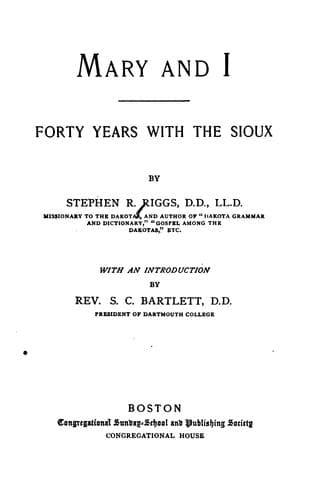
Mary and I: Forty Years with the SiouxRiggs, Stephen Return
History
Mary and I: Forty Years with the Sioux
Riggs, Stephen Return
Dakota Indians -- Missions; Riggs, Stephen Return, 1812-1883
"Just forty-three years previous to the occurrence above alluded
to, on the same beautiful site, was completed an humble edifice,
built by the hands of two inexperienced New England boys, just
setting out in life-work. The foundation-stones of that hut were
removed to make place for the present Pavilion, perchance
compose a part of it. The old structure was of oak logs,
carefully peeled. The peeling was a mistake. Twelve feet by
sixteen, and eight feet high, were the dimensions of the
edifice. Straight poles from the tamarack grove west of the lake
formed the timbers of the roof, and the roof itself was of the
bark of trees which grew on the bank of what is now called
'Bassett's Creek,' fastened with strings of the inner bark of
the bass wood. A partition of small logs divided the house into
two rooms, and split logs furnished material for a floor. The
ceiling was of slabs from the old government saw-mill, through
the kindness of Major Bliss, who was in command of Fort
Snelling. The door was made of boards split from a log with an
axe, having wooden hinges and fastenings, and was locked by
pulling in the latch-string. The single window was the gift of
the kind-hearted Major Lawrence Taliaferro, United States Indian
agent. The cash cost of the building was one shilling, New York
currency, for nails used in and about the door. 'The formal
opening' exercises consisted in reading a section from the old
book by the name of BIBLE, and prayer to Him who was its
acknowledged author. The 'banquet' consisted of mussels from the
lake, flour and water. The ground was selected by the Indian
chief of the Lake Calhoun band of Dakotas, Man-of-the-sky, by
which he showed good taste. The reason he gave for the selection
was that 'from that point the loons would be visible on the
lake.'
"The old chief and his pagan people had their homes on the
surface of that ground in the bosom of which now sleep the
bodies of deceased Christians from the city of Minneapolis, the
Lake Wood cemetery, over which these old eyes have witnessed,
dangling in the night breeze, many a Chippewa scalp, in the
midst of horrid chants, yells, and wails, widely contrasting
with the present stillness of that quiet home of those
'Who sleep the years away.'
That hut was the home of the first citizen settlers of Hennepin
county, perhaps of Minnesota, the first school-room, the first
house for divine worship, and the first mission station among
the Dakota Indians."
The departure of Mr. Pond called forth from Gen. Henry H. Sibley so
just and beautiful a tribute, that I can not forbear inserting a
portion, from the _Pioneer Press_ of St. Paul:--
Public-domain text, read in full here on John Shaqi.
Reviews
Reviews
No reviews yet
Be the first to share your thoughts on this work.
Elsewhere in the archive
Join the Discussion
Join the discussion
Sign in to leave a comment or review.
Sign InorCreate an account