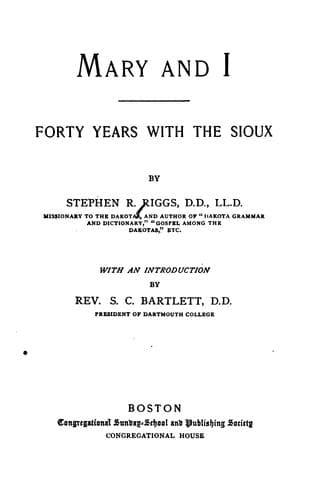
Mary and I: Forty Years with the SiouxRiggs, Stephen Return
History
Mary and I: Forty Years with the Sioux
Riggs, Stephen Return
Dakota Indians -- Missions; Riggs, Stephen Return, 1812-1883
A few months afterward he received his appointment as a missionary of
the A. B. C. F. M. to the Dakotas; and on the first day of April,
1835, Dr. Williamson, with his wife and one child, accompanied by
Miss Sarah Poage, Mrs. Williamson's sister, who afterward became Mrs.
Gideon H. Pond, and Alexander G. Huggins and family, left Ripley,
Ohio, and on the 16th of May they arrived at Fort Snelling. At this
time, the only white people in Minnesota, then a part of the
North-west Territory, were those connected with the military post at
Fort Snelling, the only post-office within the present limits of the
State; those connected with the fur-trade, except Hon. H. H. Sibley,
were chiefly Canadian French, ignorant of the English language; and
Messrs. Gideon H. and Samuel W. Pond, who came on their own account as
lay teachers of Christ to the Indians in 1834.
While stopping there for a few weeks, Dr. Williamson presided at the
organization, on the 12th of June, of the First Presbyterian
Church--the first Christian church organized within the present limits
of Minnesota. This was within the garrison at Fort Snelling, and
consisted of twenty-two members, chiefly the result of the labors of
Major Loomis among the soldiers.
Having concluded to accompany Mr. Joseph Renville, Dr. Williamson's
party embarked on the fur company's Mackinaw boat on the 22d of June;
reached Traverse des Sioux on the 30th, where they took wagons and
arrived at Lac-qui-parle on the 9th of July. There, on the north side
of the Minnesota River, and in sight of the "Lake that speaks," they
established themselves as teachers of the religion of Jesus.
Of the "Life and Labors" pressed into the next forty-four years, only
the most meager outline can be given in this article. It is now almost
two round centuries since Hennepin and Du Luth met in the camps and
villages of the Sioux on the Upper Mississippi. Then, as since, they
were recognized as the largest and most warlike tribe of Indians on
the continent. Until Dr. Williamson and his associates went among
them, there does not appear to have been any effort made to civilize
and Christianize them. With the exception of a few hundred words
gathered by army officers and others, the Dakota language was
unwritten. This was to be learned--_mastered_, which was found to be
no small undertaking, especially to one who had attained the age of
thirty-five years. While men of less energy and pluck would have
knocked off or been content to work as best they could through an
interpreter, Dr. Williamson persevered, and in less than two years was
preaching Christ to them in the language in which they were born. He
never spoke it easily nor just like an Indian, but he was readily
understood by those who were accustomed to hear him.
Public-domain text, read in full here on John Shaqi.
Reviews
Reviews
No reviews yet
Be the first to share your thoughts on this work.
Elsewhere in the archive
Join the Discussion
Join the discussion
Sign in to leave a comment or review.
Sign InorCreate an account