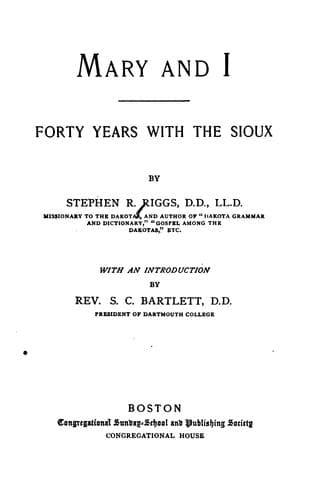
Mary and I: Forty Years with the SiouxRiggs, Stephen Return
History
Mary and I: Forty Years with the Sioux
Riggs, Stephen Return
Dakota Indians -- Missions; Riggs, Stephen Return, 1812-1883
As Mr. Renville could only interpret between the Dakotas and French,
Dr. Williamson applied himself to learning the latter language.
Through this a beginning was made in the translation of the Scriptures
into the Dakota. Late in the fall of 1839 the Gospel of Mark and some
other small portions were ready to be printed, and Dr. Williamson went
with his family to Ohio, where he spent the winter. The next printing
of portions of the Bible was done in 1842-43, when Dr. Williamson had
completed a translation of the book of Genesis. We had now commenced
to translate from the Hebrew and Greek. This was continued through all
the years of his missionary life. So far as I can remember, there was
no arrangement of work between the doctor and myself, but while I
commenced the New Testament, and, having completed that, turned to the
Psalms, and, having finished to the end of Malachi, made some steps
backward through Job, Esther, Nehemiah, and Ezra, he, commencing with
Genesis, closed his work, in the last months of his life, with Second
Chronicles, having taken in also the book of Proverbs.
Before leaving the subject of Bible translation, let me bear testimony
to the uniform kindness and courtesy which Dr. Williamson extended to
me, through all this work of more than forty years. It could hardly be
said of either of us that we were very yielding. The doctor was a man
of positive opinions, and there were abundant opportunities in
prosecuting our joint work for differences of judgment. But, while we
freely criticised each the other's work, we freely yielded to each
other the right of ultimate decision.
In the autumn of 1846, Dr. Williamson received an invitation, through
the agent at Fort Snelling, to establish a mission at Little Crow's
Village, a few miles below where St. Paul has grown up, and he at once
accepted it, gathering from it that the Lord had a work for him to do
there. And indeed he had. During the five or six years he remained
there, a small Dakota church was gathered, and an opportunity was
afforded him to exert a positive Christian influence on the white
people then gathering into the capital of Minnesota. Dr. Williamson
preached the first sermon there.
When, after the treaties of 1851, the Indians of the Mississippi were
removed, he removed with them--or, rather, went before them, and
commenced his last station at Pay-zhe-hoo-ta-zee, Yellow Medicine.
There he and his family had further opportunities "to glory in
tribulations." The first winter was one of unusual severity, and they
came near starving. But here the Lord blessed them, and permitted them
to see a native church grow up, as well as at Hazelwood, the other
mission station near by. It was during the next ten years that the
seeds of civilization and Christianity took root, and grew into a
fruitage, which, in some good manner, bore up under the storm of the
outbreak in 1862, and resulted in a great harvest afterward.
Public-domain text, read in full here on John Shaqi.
Reviews
Reviews
No reviews yet
Be the first to share your thoughts on this work.
Elsewhere in the archive
Join the Discussion
Join the discussion
Sign in to leave a comment or review.
Sign InorCreate an account