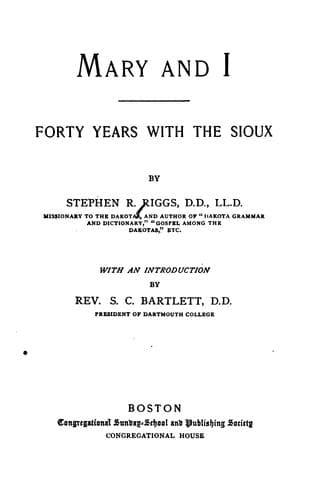
Mary and I: Forty Years with the SiouxRiggs, Stephen Return
History
Mary and I: Forty Years with the Sioux
Riggs, Stephen Return
Dakota Indians -- Missions; Riggs, Stephen Return, 1812-1883
The original Dakota presbytery was organized at Lac-qui-parle in the
first days of October, 1844. Dr. Williamson and myself brought our
letters from the presbytery of Ripley, Ohio, and Samuel W. Pond
brought his from an Association in Connecticut. The bounds of this
presbytery were not accurately defined, and so for years it absorbed
all the ministers of the Gospel of the Presbyterian and Congregational
orders who came into the Minnesota country. By and by the presbyteries
of St. Paul and Minnesota were organized; but the Dakota presbytery
still covered the country of the Minnesota River.
At a meeting of this presbytery at Mankato in the spring of 1865, when
our first Dakota preacher, Rev. John B. Renville, was licensed, an
incident took place which illustrates the meekness and magnanimity of
Dr. Williamson's character. On its own adjournment the presbytery had
convened and was opened with a sermon by Dr. Williamson, in the
evening, in the Presbyterian church. He took occasion to present the
subject of our duties to the down-trodden races, the African and the
Indian. Doubtless some who heard the discourse did not approve of it.
But no exceptions would have been taken if the Jewett family, out a
few miles from the town, had not been killed that night by a Sioux
war-party. Men were so unreasonable as to claim that the preaching
and the preacher had some kind of casual relation with the killing.
The next day, Mankato was in a ferment. An indignation meeting was
held, and a committee of citizens was sent to the Presbyterian church
to require Dr. Williamson to leave their town. Some of the members of
the presbytery were indignant at this demand; but the good doctor
chose to retire to his home at St. Peter, assuring the excited and
unreasonable men of Mankato that he could have had no knowledge of the
presence of the war-party, and certainly had no sympathy with their
wicked work.
In years after this, I traveled hundreds of miles, often alone with
Dr. Williamson, and while we conversed freely of all our experiences,
and of the way God had led us, I do not remember that I ever heard him
refer to this ill treatment of the people of Mankato. Like his Master,
he had learned obedience by the things he suffered.
Never brilliant, he was yet, by his capacity for long-continued,
severe exertion, and by systematic, persevering industry, enabled to
accomplish an almost incredible amount of labor. His life was a grand
one, made so by his indomitable perseverance in the line of lifting up
the poor and those who had no helper.
From the beginning he had an unshaken faith in his work. He fully
believed in the ability of the Indians to become civilized and
Christianized. He had an equally strong and abiding faith in the power
of the Gospel to elevate and save even them. Then add to these his
personal conviction that God had, by special providences, called him
to this work, and we have a threefold cord of faith, that was not
easily broken.
Public-domain text, read in full here on John Shaqi.
Reviews
Reviews
No reviews yet
Be the first to share your thoughts on this work.
Elsewhere in the archive
Join the Discussion
Join the discussion
Sign in to leave a comment or review.
Sign InorCreate an account