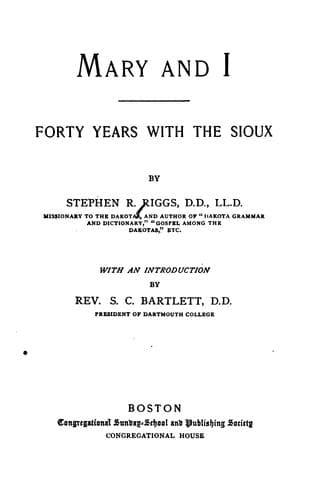
Mary and I: Forty Years with the SiouxRiggs, Stephen Return
History
Mary and I: Forty Years with the Sioux
Riggs, Stephen Return
Dakota Indians -- Missions; Riggs, Stephen Return, 1812-1883
On the 6th of December I remember coming home from Mr. Renville's,
where we had been all the afternoon obtaining translations. Then there
was hurrying to and fro, and the first baby came into our family of
two. From that time on we were three, and the little Zitkadan-Washta,
as the Indians named him, grew as other children grow, and did what
most children don't do, _viz._, learn to go _down_ stairs before he
did _up_, because we lived upstairs, and all children can manage to go
away from home, when they can't or won't come back of themselves.
In those years our annual allowance from the treasury of the board was
$250. This was more than the other families in the mission had
proportionally. But it required considerable economy and great care in
expenditure to make the ends meet. Not knowing the price of quinine,
and thinking four ounces could not be a great amount, we were much
surprised to find the bill $16. But Dr. Turner of Fort Snelling kindly
took it off our hands.
Once we were discussing the question of how much additional expense
the baby would be, when I said, "About two dollars." Thereafter Mr. S.
W. Pond, who was present at the time, called the boy "Mazaska nonpa."
A PLEASANT TRIP.
In the second month of 1840, our _three_ became _four_. And when the
leaves came out and the flowers began to appear, the mother had a
great desire to go somewhere. But the only place to go was to Fort
Snelling. And so, leaving Chaskay and taking Hapan, we crossed the
prairie to the Traverse des Sioux in company with Mr. Renville's
caravan. The expectation was that the fur company's boat would be
there. But it was not; nor even a canoe, save a little leaky one,
which barely aided us in crossing the St. Peters. The journey through
the Big Woods was over logs and through swamps and streams for
seventy-five miles. We had two horses but no saddle. Our tent and
bedding and such things as we must have on the journey were strapped
on the horses. The mother rode one,--not very comfortable, as may be
supposed,--but the baby girl had a better ride on a Dakota woman's
back. At the end of ten miles, "le grand canoe" was found, in which
they took passage. That ten miles was destined to be remembered by our
return also; for there where the town of Le Sueur now stands our bark
canoe finally failed us, and, without an Indian woman to carry the
baby, we walked up to the Traverse, through the wet grass. Altogether,
that was a trip to be remembered.
One other thing comes to my mind about our first "little lady." There
was only one window in our upstairs room. On the outside of that the
mother had a shelf fixed to set out milk on. One morning, when every
one was busy or out, the little girl, not two years old, climbed out
of the window and perched herself on that shelf. It gave us a good
scare.
JOURNEY TO NEW ENGLAND.
Public-domain text, read in full here on John Shaqi.
Reviews
Reviews
No reviews yet
Be the first to share your thoughts on this work.
Elsewhere in the archive
Join the Discussion
Join the discussion
Sign in to leave a comment or review.
Sign InorCreate an account