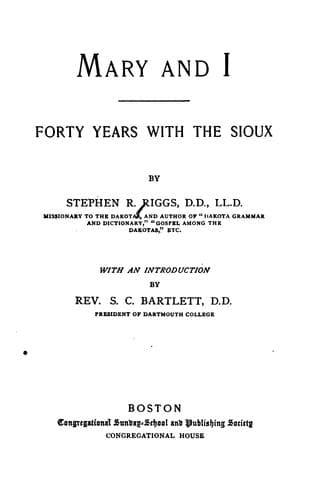
Mary and I: Forty Years with the SiouxRiggs, Stephen Return
History
Mary and I: Forty Years with the Sioux
Riggs, Stephen Return
Dakota Indians -- Missions; Riggs, Stephen Return, 1812-1883
"Eagle Help" was a good specimen of a war prophet and war leader among
the Dakotas. At the time of the commencement of the mission, he was a
man of family and in middle age, but he was the first man to learn to
read and write his language. And from the very first, no one had
clearer apprehensions of the advantages of that attainment. He soon
became one of the best helps in studying the Dakota, and the best
critical helper in translations. He wanted good pay for a service, but
he was ever ready to do it, and always reliable. When my horse failed
me, on the trip up from Fort Snelling, and I had walked fifty miles,
Eagle Help was ready, for a consideration (my waterproof coat), to go
on foot and bring up the baggage I had left. And in the early spring
of 1839, when Mr. Pond would remove his family--wife and child--to
join his brother in the work near Fort Snelling, Eagle Help was the
man to pilot his canoe down the Minnesota.
But, notwithstanding his readiness to learn and to impart, to receive
help and give help--notwithstanding his knowledge of the "new way," of
which his wife was a follower, and his near relations to us in our
missionary work, he did not, at once, abandon his Dakota customs, one
of which was going on the war-path.
As a war prophet, he claimed to be able to get into communication with
the spirit world, and thus to be made a _seer_. After fasting and
praying and dancing the circle dance, a _vision_ of the enemies he
sought to kill would come to him. He was made to see, in this trance
or dream, whichever it might be, the whole panorama, the river or
lake, the prairie or wood, and the Ojibwas in canoes or on the land,
and the spirit in the vision said to him, "Up, Eagle Help, and kill."
This vision and prophecy had heretofore never failed, he said.
And so, when he came back from escorting Mr. Gavan and Mr. Pond to the
Mississippi River, he determined to get up a war party. He made his
"yoomne wachepe" (circle dance), in which the whole village
participated--he dreamed his dream, he saw his vision, and was
confident of a successful campaign. About a score of young men painted
themselves for the war; they fasted and feasted and drilled by dancing
the no-flight dance, and made their hearts firm by hearing the brave
deeds of older warriors, who were now _hors de combat_ by age.
Public-domain text, read in full here on John Shaqi.
Reviews
Reviews
No reviews yet
Be the first to share your thoughts on this work.
Elsewhere in the archive
Join the Discussion
Join the discussion
Sign in to leave a comment or review.
Sign InorCreate an account