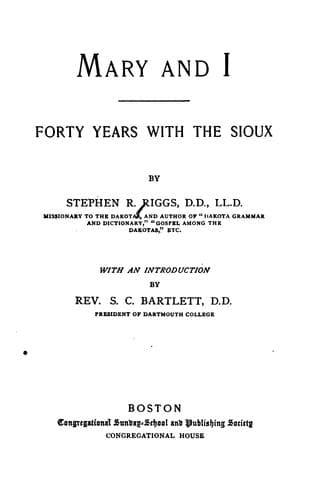
Mary and I: Forty Years with the SiouxRiggs, Stephen Return
History
Mary and I: Forty Years with the Sioux
Riggs, Stephen Return
Dakota Indians -- Missions; Riggs, Stephen Return, 1812-1883
About this time Mary wrote: "A few days after T. was drowned, some of
the Indians here, entirely regardless of our affliction, came and
demanded provisions as pay for the logs in our cabin. Mr. Riggs had
previously given them two barrels of flour, and it was out of our
power to aid them any more then, although Mr. R. told them, after
their cruel speeches, that he would endeavor to purchase some corn,
when the Fur Company's boat came up. They threatened killing our
cattle and tearing down our cabin, and husband's proposition did not
prevent their executing the first part of their threat. Just one week
after dear T. was drowned, one ox was killed, and in eight days more
the other shared the same fate. Then we _felt_ that it was very
probable our cabin would be demolished next."
* * * * *
The summer was wearing away. We were getting some access to the
people. On the Sabbath, we could gather in a few, to be present while
we sang Dakota hymns and read the Bible and prayed. But there was a
good deal of opposition. As our oxen had been killed and eaten, and we
were approaching the winter, it was necessary that we have some means
of drawing our firewood. So I bought _one_ ox, and harnessed him as
the Red River people do. He was a faithful servant to us during that
winter, but the next summer he too was killed and eaten. This time
they came boldly, and broke open our stable, and killed and carried
away the animal. It seemed as if they were determined that we should
not stay. Did the Lord mean to have us give up our work there? We did
not want to decide that question hastily.
In the meantime, the field was proving to be a very unpromising as
well as difficult one, because of the great quantities of whiskey
brought in. St. Paul was then made up of a few grog-shops, which
relied chiefly on the trade with the Indians. They took pelts, or
guns, or blankets, or horses--whatever the Indian had to give for his
keg of whiskey. The trade was a good one. The Lower Sioux bought for
the Upper ones, and helped them to buy; and those at the Traverse and
other points engaged in the carrying trade. When a keg was brought up,
a general _drunk_ was the result; but there was enough left to fill
with water, and carry up farther and sell for a pony. This made our
work very discouraging. Besides, we were often annoyed by the visits
of drunken Indians. Sometimes they came with guns and knives. So that
we all felt the strain of those years, and we often asked one another,
"What good is to come of this?"
Public-domain text, read in full here on John Shaqi.
Reviews
Reviews
No reviews yet
Be the first to share your thoughts on this work.
Elsewhere in the archive
Join the Discussion
Join the discussion
Sign in to leave a comment or review.
Sign InorCreate an account