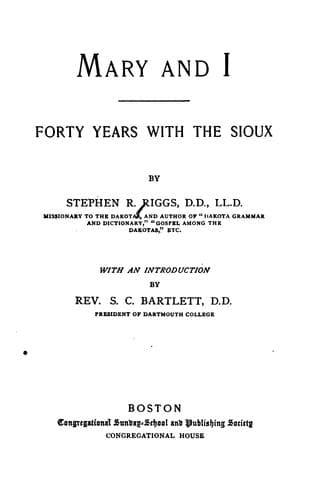
Mary and I: Forty Years with the SiouxRiggs, Stephen Return
History
Mary and I: Forty Years with the Sioux
Riggs, Stephen Return
Dakota Indians -- Missions; Riggs, Stephen Return, 1812-1883
The time came when it was decided that Mary and I should go back to
Lac-qui-parle. The four years since we left had brought many changes.
They had been years of discouragement and hardship all along the line.
The brothers Pond had built among the people of their first love--the
old Lake Calhoun band, now located a short distance up from the mouth
of the Minnesota. There they had a few who came regularly to worship
and to learn the Way of Life. But the mass of the people of Cloud
Man's village were either indifferent or opposed to the Gospel of
Christ.
At Lac-qui-parle, where had been the best seed-sowing and harvesting
for the first seven years, the work had gone backward. Bad corn years
had driven some of the native Christians to take refuge among the
annuity Indians of the Mississippi. Temptations of various kinds had
drawn away others--they had stumbled and fallen. Persecutions from
the heathen party had deterred others, and some had fallen asleep in
Christ. Among these last was Mr. Joseph Renville, who had stood by the
work from the beginning. He had passed away in the month of March; and
thus the Lac-qui-parle church was reduced to less than half its
members of four years ago.
Out of this church there had gone a half a dozen or so, chiefly women,
down to Kaposia, or Little Crow's village, which was on the
Mississippi, a few miles below the site of St. Paul. Through them,
more than any other influence perhaps, there came an invitation, from
Little Crow and the head men of the village, to Dr. Williamson,
through the Indian agent at Fort Snelling, to come down and open a
school and a mission. This application was considered at the meeting
of the Dakota mission held at the Traverse, and the voices were in
favor of acceptance. But if Dr. Williamson left Lac-qui-parle, that
involved the necessity of our returning thither. This proposition Mary
could not entertain willingly. True, the work at the Traverse had been
full of hardships and suffering, but the very sufferings and sorrows,
and especially that great first sorrow, had strongly wedded her
affections to the place and the people. It was hard to leave those
Oaks of Weeping. She could not see that it was right; still, she would
not refuse to obey orders.
And so the month of September, 1846, found us travelling over the same
road that we had gone on our first journey, just nine years before.
Then we two had gone; now we had with us our four little ones, but it
was a sad journey. The mother's heart was not convinced, nor was it
satisfied we had done right, until some time after we reached
Lac-qui-parle.
MARY'S STORY.
"TRAVERSE DES SIOUX, Sept. 17, 1846.
"This is probably the last letter I shall write you from this
spot so dear to us. If I could see that it was duty to go, it
would cheer me in the preparations for our departure, but I
cannot feel that the interests of the mission required such a
sacrifice as leaving this home is to me.
Public-domain text, read in full here on John Shaqi.
Reviews
Reviews
No reviews yet
Be the first to share your thoughts on this work.
Elsewhere in the archive
Join the Discussion
Join the discussion
Sign in to leave a comment or review.
Sign InorCreate an account