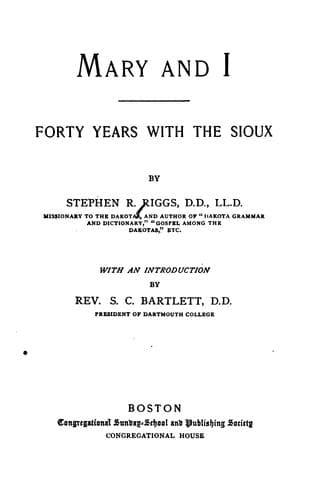
Mary and I: Forty Years with the SiouxRiggs, Stephen Return
History
Mary and I: Forty Years with the Sioux
Riggs, Stephen Return
Dakota Indians -- Missions; Riggs, Stephen Return, 1812-1883
The summer of 1851 came, which brought great changes, and prepared the
way for others. It was one of the very wet summers in Minnesota, when
the streams were flooded all the summer through. In making our trip
for provisions in the spring, we were detained at the crossing of one
stream for almost a whole week. In the latter part of June, the
Indians from all along the upper part of the Minnesota were called
down to Traverse des Sioux, to meet commissioners of the government.
They were obliged to swim at many places. The Minnesota was very high,
spreading its waters over all the low bottom contiguous to the mission
premises. Governor Ramsay and Commissioner Lea were there for the
government. General Sibley and the fur-traders generally were present,
with a large number of the Wahpaton and Sisseton Sioux.
The Fourth of July was to be celebrated grandly, and Mr. Hopkins had
consented to take a part in the celebration, but the Lord disposed
otherwise. In the early morning, Mr. Hopkins went to bathe in the
overflow of the river. When the family breakfast was ready he had not
returned. He was sought for, and his clothes alone were found. He had
gone up through the flood of water. It was supposed that,
unintentionally, he had waded in beyond his depth, and, as he could
not swim, was unable again to reach the land.
This was the second great sorrow that came, in the same way, to the
mission band of Traverse des Sioux. It threw a pall over the
festivities of the day. The Indians said again the Oonktehe--their
Neptune--was angry and had taken the _wechasta wakan_. But the mission
families were enabled to say, "It is the Lord." When the body floated
it was caught in fishing nets, and carefully taken up and buried by
the "Oaks of Weeping." Mr. Hopkins did not live to see much matured
fruit of his labors, but he had put in eight years of good, honest
work for the Master, among the Dakotas, and he has his reward.
The Treaty was made, which, with one consummated immediately after, at
Mendota, with the Lower Sioux, conveyed to the white people all their
land in Minnesota, except a reserve on the upper part of the river.
These treaties had an important bearing on our mission work and on all
the eastern Dakotas.
Public-domain text, read in full here on John Shaqi.
Reviews
Reviews
No reviews yet
Be the first to share your thoughts on this work.
Elsewhere in the archive
Join the Discussion
Join the discussion
Sign in to leave a comment or review.
Sign InorCreate an account