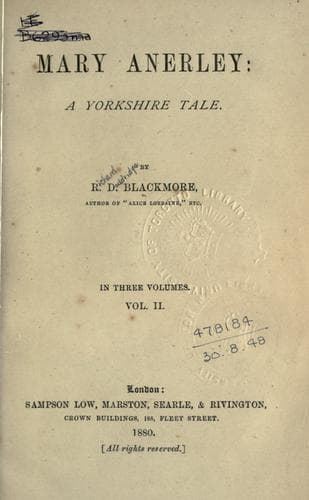
Mary Anerley: A Yorkshire TaleBlackmore, R. D. (Richard Doddridge)
General
Mary Anerley: A Yorkshire Tale
Blackmore, R. D. (Richard Doddridge)
Yorkshire (England) -- Fiction
“Well, ma'am, they may have been unknown animals; but good they were,
and as fresh as the day. Now, you will remember that my desire is to do
good. I have nothing to do with the revenue, nor the magistrates,
nor his Majesty. I shall not even go to your parson, who is the chief
authority, I am told; for I wish this matter to be kept quiet, and
beside the law altogether. The whole credit of it shall belong to you,
and a truly good action you will have performed, and done a little good
for your own good self. As for this trinket, I do not leave it with you,
but I leave you this model in wax, ma'am, made by my daughter, who is
very clever. From this you can judge quite as well as from the other.
If there are any more of these things in Flamborough, as I have strong
reason to believe, you will know best where to find them, and I need
not tell you that they are almost certain to be in the possession of a
woman. You know all the women, and you skillfully inquire, without even
letting them suspect it. Now I shall just stretch my legs a little,
and look at your noble prospect, and in three hours' time a little
more refreshment, and then, Mistress Precious, you see the last of your
obedient servant, until you demand from him fifty gold guineas.”
After seeing to his horse again, he set forth for a stroll, in the
course of which he met with Dr. Upround and his daughter. The rector
looked hard at this distinguished stranger, as if he desired to know
his name, and expected to be accosted by him, while quick Miss Janetta
glanced with undisguised suspicion, and asked her father, so that Mr.
Mordacks overheard it, what business such a man could have, and what
could he come spying after, in their quiet parish? The general factor
raised his hat, and passed on with a tranquil smile, taking the crooked
path which leads along and around the cliffs, by way of the light-house,
from the north to the southern landing. The present light-house was not
yet built, but an old round tower, which still exists, had long been
used as a signal station, for semaphore by day, and at night for
beacon, in the times of war and tumult; and most people called it the
“Monument.” This station was now of very small importance, and sometimes
did nothing for a year together; but still it was very good and useful,
because it enabled an ancient tar, whose feet had been carried away by
a cannon-ball, to draw a little money once a month, and to think himself
still a fine British bulwark.
Public-domain text, read in full here on John Shaqi.
Reviews
Reviews
No reviews yet
Be the first to share your thoughts on this work.
Elsewhere in the archive
Join the Discussion
Join the discussion
Sign in to leave a comment or review.
Sign InorCreate an account