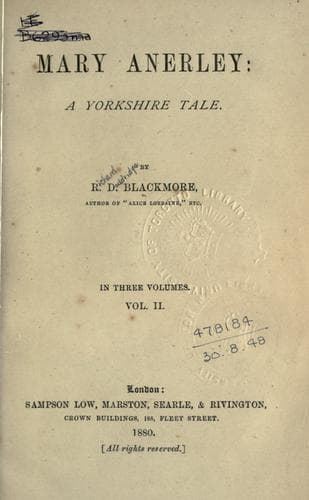
Mary Anerley: A Yorkshire TaleBlackmore, R. D. (Richard Doddridge)
General
Mary Anerley: A Yorkshire Tale
Blackmore, R. D. (Richard Doddridge)
Yorkshire (England) -- Fiction
Here was Mary, as blithe as a lark, and as petted as a robin-redbreast,
by no means pining, or even hankering, for any other robin. She was not
the girl to give her heart before it was even asked for; and hitherto
she had regarded the smuggler with pity more than admiration. For in
many points she was like her father, whom she loved foremost of the
world; and Master Anerley was a law-abiding man, like every other
true Englishman. Her uncle Popplewell was also such, but exerted his
principles less strictly. Moreover, he was greatly under influence of
wife, which happens more freely to a man without children, the which are
a source of contradiction. And Mistress Popplewell was a most thorough
and conscientious free-trader.
Now Mary was from childhood so accustomed to the sea, and the relish
of salt breezes, and the racy dance of little waves that crowd on one
another, and the tidal delivery of delightful rubbish, that to fail
of seeing the many works and plays and constant variance of her never
wearying or weary friend was more than she could long put up with. She
called upon Lord Keppel almost every day, having brought him from home
for the good of his health, to gird up his loins, or rather get his
belly girths on, and come along the sands with her, and dig into new
places. But he, though delighted for a while with Byrsa stable, and
the social charms of Master Popplewell's old cob, and a rick of fine
tan-colored clover hay and bean haulm, when the novelty of these
delights was passed, he pined for his home, and the split in his crib,
and the knot of hard wood he had polished with his neck, and even the
little dog that snapped at him. He did not care for retired people--as
he said to the cob every evening--he liked to see farm-work going on, or
at any rate to hear all about it, and to listen to horses who had worked
hard, and could scarcely speak, for chewing, about the great quantity
they had turned of earth, and how they had answered very bad words with
a bow. In short, to put it in the mildest terms, Lord Keppel was giving
himself great airs, unworthy of his age, ungrateful to a degree, and
ungraceful, as the cob said repeatedly; considering how he was fed, and
bedded, and not a thing left undone for him. But his arrogance soon had
to pay its own costs.
Public-domain text, read in full here on John Shaqi.
Reviews
Reviews
No reviews yet
Be the first to share your thoughts on this work.
Elsewhere in the archive
Join the Discussion
Join the discussion
Sign in to leave a comment or review.
Sign InorCreate an account