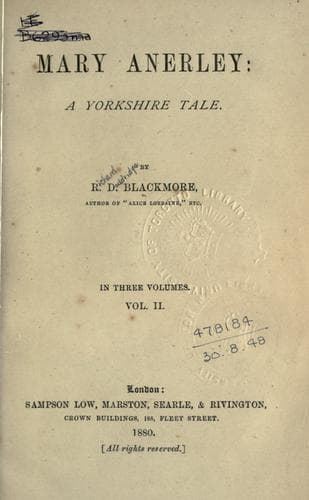
Mary Anerley: A Yorkshire TaleBlackmore, R. D. (Richard Doddridge)
General
Mary Anerley: A Yorkshire Tale
Blackmore, R. D. (Richard Doddridge)
Yorkshire (England) -- Fiction
That storm on the festival of St. Michael broke up the short summer
weather of the north. A wet and tempestuous month set in, and the
harvest, in all but the very best places, lay flat on the ground,
without scythe or sickle. The men of the Riding were not disturbed by
this, as farmers would have been in Suffolk; for these were quite used
to walk over their crops, without much occasion to lift their feet. They
always expected their corn to be laid, and would have been afraid of it
if it stood upright. Even at Anerley Farm this salam of the wheat was
expected in bad seasons; and it suited the reapers of the neighborhood,
who scarcely knew what to make of knees unbent, and upright discipline
of stiff-cravated ranks.
In the northwest corner of the county, where the rocky land was mantled
so frequently with cloud, and the prevalence of western winds bore sway,
an upright harvest was a thing to talk of, as the legend of a century,
credible because it scarcely could have been imagined. And this year it
would have been hard to imagine any more prostrate and lowly position
than that of every kind of crop. The bright weather of August and
attentions of the sun, and gentle surprise of rich dews in the morning,
together with abundance of moisture underneath, had made things look as
they scarcely ever looked--clean, and straight, and elegant. But none of
them had found time to form the dry and solid substance, without which
neither man nor his staff of life can stand against adversity.
“My Lady Philippa,” as the tenants called her, came out one day to see
how things looked, and whether the tenants were likely to pay their
Michaelmas rents at Christmas. Her sister, Mrs. Carnaby, felt like
interest in the question, but hated long walks, being weaker and less
active, and therefore rode a quiet pony. Very little wheat was grown on
their estates, both soil and climate declining it; but the barley crop
was of more importance, and flourished pretty well upon the southern
slopes. The land, as a rule, was poor and shallow, and nourished more
grouse than partridges; but here and there valleys of soft shelter and
fair soil relieved the eye and comforted the pocket of the owner. These
little bits of Goshen formed the heart of every farm; though oftentimes
the homestead was, as if by some perversity, set up in bleak and barren
spots, outside of comfort's elbow.
The ladies marched on, without much heed of any other point than
one--would the barley crop do well? They had many tenants who trusted
chiefly to that, and to the rough hill oats, and wool, to make up in
coin what part of their rent they were not allowed to pay in kind.
For as yet machinery and reeking factories had not besmirched the
country-side.
“How much further do you mean to go, Philippa?” asked Mrs. Carnaby,
although she was not travelling by virtue of her own legs. “For my part,
I think we have gone too far already.”
Public-domain text, read in full here on John Shaqi.
Reviews
Reviews
No reviews yet
Be the first to share your thoughts on this work.
Elsewhere in the archive
Join the Discussion
Join the discussion
Sign in to leave a comment or review.
Sign InorCreate an account