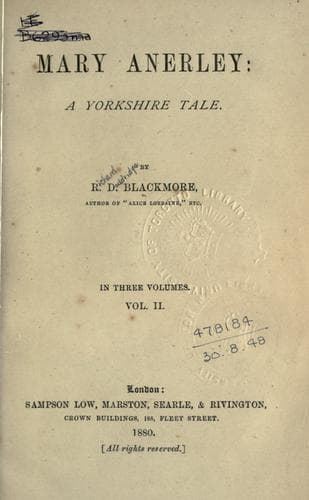
Mary Anerley: A Yorkshire TaleBlackmore, R. D. (Richard Doddridge)
General
Mary Anerley: A Yorkshire Tale
Blackmore, R. D. (Richard Doddridge)
Yorkshire (England) -- Fiction
Mary was pleased with this conclusion, and glad to have some one who did
not condemn her; hopeful, moreover, that her mother's influence might
have some effect by-and-by. But for the present it seemed to do more
harm than good; because the farmer, having quite as much jealousy as
justice, took it into silent dudgeon that the mother of his daughter,
who regularly used to be hard upon her for next to nothing, should now
turn round and take her part, from downright womanism, in the teeth of
all reason, and of her own husband! Brave as he was, he did not put it
to his wife in so strong a way as that; but he argued it so to himself,
and would let it fly forth, without thinking twice about it, if they
went on in that style much longer, quite as if he were nobody, and
they could do better without him. Little he knew, in this hurt state of
mind--for which he should really have been too old--how the heart of
his child was slow and chill, stupid with the strangeness he had made,
waiting for him to take the lead, or open some door for entrance,
and watching for the humors of the elder body, as the young of past
generations did. And sometimes, faithful as she was to plighted truth
and tenderness, one coaxing word would have brought her home to the arms
that used to carry her.
But while such things were waiting to be done till they were thought of,
the time for doing them went by; and to think of them was memory. Master
Popplewell had told Captain Anerley continually what his opinions were,
fairly giving him to know on each occasion that they were to be taken
for what they were worth; that it did not follow, from his own success
in life, that he might not be mistaken now; and that he did not care a
d--n, except for Christian feeling, whether any fool hearkened to him
twice or not. He said that he never had been far out in any opinion he
had formed in all his life; but none the more for that would he venture
to foretell a thing with cross-purposes about it. A man of sagacity and
dealings with the world might happen to be right ninety-nine times in
a hundred, and yet he might be wrong the other time. Therefore he would
not give any opinion, except that everybody would be sorry by-and-by,
when things were too late for mending.
To this the farmer listened with an air of wisdom, not put forward too
severely; because Brother Popplewell had got a lot of money, and must
behave handsomely when in a better world. The simplest way of treating
him was just to let him talk--for it pleased him, and could do no
harm--and then to recover self-content by saying what a fool he was when
out of hearing. The tanner partly suspected this; and it put his nature
upon edge; for he always drove his opinions in as if they were so many
tenpenny nails, which the other man must either clinch or strike back
into his teeth outright. He would rather have that than flabby silence,
as if he were nailing into dry-rot.
Public-domain text, read in full here on John Shaqi.
Reviews
Reviews
No reviews yet
Be the first to share your thoughts on this work.
Elsewhere in the archive
Join the Discussion
Join the discussion
Sign in to leave a comment or review.
Sign InorCreate an account