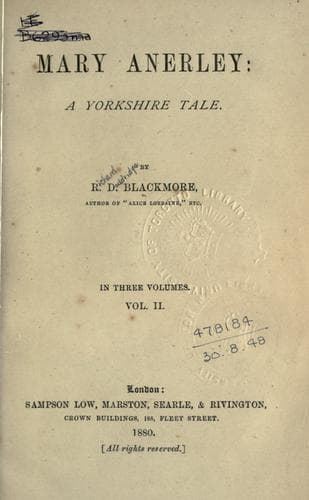
Mary Anerley: A Yorkshire TaleBlackmore, R. D. (Richard Doddridge)
General
Mary Anerley: A Yorkshire Tale
Blackmore, R. D. (Richard Doddridge)
Yorkshire (England) -- Fiction
With these words the wealthy merchant of the Zuyder-Zee drew forth
his ancient inkhorn, smeared with the dirt of countless contracts, and
signed an acquittance which the smuggler had prepared. But he signed it
with a sigh, as a man declares that a favorite horse must go at last;
sighing, not for the money, but the memories that go with it. Then, as
the wind began to pipe, and the roll of the sea grew heavier, the solid
Dutchman was lowered carefully into his shore boat, and drew the apron
over his great and gouty legs.
“I vos married in dat zhips,” he shouted back, with his ponderous fist
wagging up at Robin Lyth, “Dis taime you will have de bad luck, sir.”
“Well, mynheer, you have only to pay the difference, and the ketch will
do; the bilander sails almost as fast.”
But Master Van Dunck only heaved another sigh, and felt that his leather
bag was safe and full in his breeches pocket. Then he turned his eyes
away, and relieved his mind by swearing at his men.
Now this was off the Isle of Texel, and the time was Sunday morning, the
very same morning which saw the general factor sitting to be preached
at. The flotilla of free trade was putting forth upon its great emprise,
and Van Dunck (who had been ship's husband) came to speed them from
their moorings.
He took no risk, and to him it mattered little, except as a question of
commission; but still he enjoyed the relish of breaking English law most
heartily. He hated England, as a loyal Dutchman, for generations, was
compelled to do; and he held that a Dutchman was a better sailor, a
better ship-builder, and a better fighter than the very best Englishman
ever born. However, his opinions mattered little, being (as we must
feel) absurd. Therefore let him go his way, and grumble, and reckon his
guilders. It was generally known that he could sink a ship with money;
and when such a man is insolent, who dares to contradict him?
The flotilla in the offing soon ploughed hissing furrows through the
misty waves. There were three craft, all of different rig--a schooner,
a ketch, and the said bilander. All were laden as heavily as speed and
safety would allow, and all were thoroughly well manned. They laid their
course for the Dogger Bank, where they would receive the latest news
of the disposition of the enemy. Robin Lyth, high admiral of smugglers,
kept to his favorite schooner, the Glimpse, which had often shown a
fading wake to fastest cutters. His squadron was made up by the ketch,
Good Hope, and the old Dutch coaster, Crown of Gold. This vessel, though
built for peaceful navigation and inland waters, had proved herself so
thoroughly at home in the roughest situations, and so swift of foot,
though round of cheek, that the smugglers gloried in her and the good
luck which sat upon her prow. They called her “the lugger,” though her
rig was widely different from that, and her due title was “bilander.”
She was very deeply laden now, and, having great capacity, appeared an
unusually tempting prize.
Public-domain text, read in full here on John Shaqi.
Reviews
Reviews
No reviews yet
Be the first to share your thoughts on this work.
Elsewhere in the archive
Join the Discussion
Join the discussion
Sign in to leave a comment or review.
Sign InorCreate an account