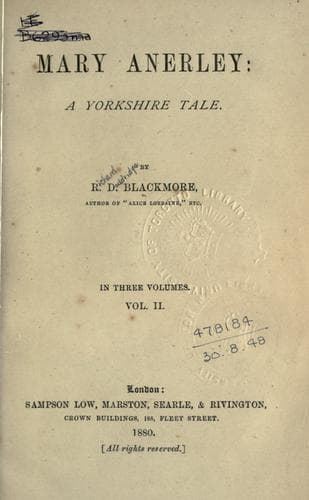
Mary Anerley: A Yorkshire TaleBlackmore, R. D. (Richard Doddridge)
General
Mary Anerley: A Yorkshire Tale
Blackmore, R. D. (Richard Doddridge)
Yorkshire (England) -- Fiction
“No fear, commander. If it is as we suppose, it is high time to make a
strong example.”
Hours had been lost, as the captains of the cruisers knew too well
by this time. Robin Lyth's stratagem had duped them all, while the
contraband cargoes might be landed safely, at either extremity of their
heat. By the aid of the fishing-boats, he had learned their manoeuvres
clearly, and outmanoeuvred them.
Now it would have been better for him, perhaps, to have been content
with a lesser triumph, and to run his own schooner, the Glimpse, further
south, toward Hornsea, or even Aldbrough. Nothing, however, would
satisfy him but to land his fine cargo at Carroway's own door--a piece
of downright insolence, for which he paid out most bitterly. A man
of his courage and lofty fame should have been above such vindictive
feelings. But, as it was, he cherished and, alas! indulged a certain
small grudge against the bold lieutenant, scarcely so much for
endeavoring to shoot him, as for entrapping him at Byrsa Cottage, during
the very sweetest moment of his life. “You broke in disgracefully,” said
the smuggler to himself, “upon my privacy when it should have been most
sacred. The least thing I can do is to return your visit, and pay my
respects to Mrs. Carroway and your interesting family.”
Little expecting such a courtesy as this, the vigilant officer was
hurrying about, here, there, and almost everywhere (except in the right
direction), at one time by pinnace, at another upon horseback, or on his
unwearied though unequal feet. He carried his sword in one hand, and his
spy-glass in the other, and at every fog he swore so hard that he
seemed to turn it yellow. With his heart worn almost into holes, as
an overmangled quilt is, by burdensome roll of perpetual lies, he
condemned, with a round mouth, smugglers, cutters, the coast-guard and
the coast itself, the weather, and, with a deeper depth of condemnation,
the farmers, landladies, and fishermen. For all of these verily seemed
to be in league to play him the game which school-boys play with a
gentle-faced new-comer--the game of “send the fool further.”
John Gristhorp, of the “Ship Inn,” at Filey, had turned out his
visitors, barred his door, and was counting his money by the fireside,
with his wife grumbling at him for such late hours as half past ten of
the clock in the bar, that night when the poor bilander ended her long
career as aforesaid. Then a thundering knock at the door just fastened
made him upset a little pyramid of pence, and catch up the iron
candlestick.
“None of your roistering here!” cried the lady. “John, you know better
than to let them in, I hope.”
“Copper coomth by daa, goold coomth t'naight-time,” the sturdy publican
answered, though resolved to learn who it was before unbarring.
“In the name of the King, undo this door,” a deep stern voice resounded,
“or by royal command we make splinters of it.”
Public-domain text, read in full here on John Shaqi.
Reviews
Reviews
No reviews yet
Be the first to share your thoughts on this work.
Elsewhere in the archive
Join the Discussion
Join the discussion
Sign in to leave a comment or review.
Sign InorCreate an account