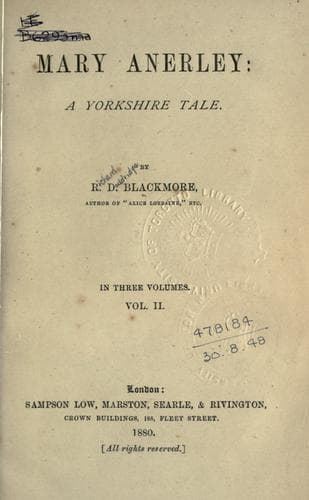
Mary Anerley: A Yorkshire TaleBlackmore, R. D. (Richard Doddridge)
General
Mary Anerley: A Yorkshire Tale
Blackmore, R. D. (Richard Doddridge)
Yorkshire (England) -- Fiction
“Poor dear, you shall not have your rest disturbed,” Dr. Upround said,
sweetly, as he closed the door behind her; “you are much too good a
girl for other people's plagues to visit you.” Then, as he saddled his
pleasant old nose with the tranquil span of spectacles, the smile on his
lips and the sigh of his breast arrived at a quiet little compromise. He
was proud of his daughter, her quickness and power to get the upper
turn of words with him; but he grieved at her not having any deep
impressions, even after his very best sermons. But her mother always
told him not to be in any hurry, for even she herself had felt no very
profound impressions until she married a clergyman; and that argument
always made him smile (as invisibly as possible), because he had not
detected yet their existence in his better half. Such questions are
most delicate, and a husband can only set mute example. A father, on
the other hand, is bound to use his pastoral crook upon his children
foremost.
“Now for this letter,” said Dr. Upround, holding council with himself;
“evidently a good clerk, and perhaps a first-rate scholar. One of the
very best Greek scholars of the age does all his manuscript in printing
hand, when he wishes it to be legible. And a capital plan it is--without
meaning any pun. I can read this like a gazette itself.”
“REVEREND AND WORSHIPFUL SIR,--Your long and highly valued kindness
requires at least a word from me, before I leave this country. I have
not ventured into your presence, because it might place you in a very
grave predicament. Your duty to King and State might compel you with
your own hand to arrest me; and against your hand I could not strive.
The evidence brought before you left no choice but to issue a warrant
against me, though it grieved your kind heart to do that same. Sir, I
am purely innocent of the vile crime laid against me. I used no fire-arm
that night, neither did any of my men. And it is for their sake, as well
as my own, that I now take the liberty of writing this. Failing of me,
the authorities may bring my comrades to trial, and convict them. If
that were so, it would become my duty as a man to surrender myself,
and meet my death in the hope of saving them. But if the case is sifted
properly, they must be acquitted; for no fire-arm of any kind was in my
boat, except one pair of pistols, in a locker under the after thwart,
and they happened to be unloaded. I pray you to verify this, kind sir.
My firm belief is that the revenue officer was shot by one of his own
men; and his widow has the same opinion. I hear that the wound was in
the back of the head. If we had carried fire-arms, not one of us could
have shot him so.
Public-domain text, read in full here on John Shaqi.
Reviews
Reviews
No reviews yet
Be the first to share your thoughts on this work.
Elsewhere in the archive
Join the Discussion
Join the discussion
Sign in to leave a comment or review.
Sign InorCreate an account