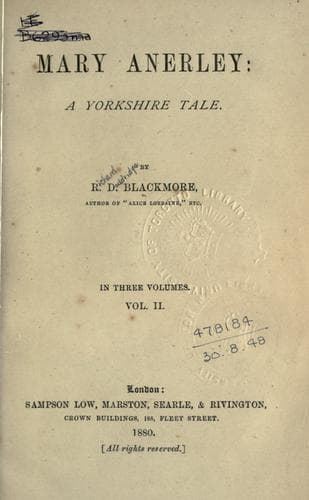
Mary Anerley: A Yorkshire TaleBlackmore, R. D. (Richard Doddridge)
General
Mary Anerley: A Yorkshire Tale
Blackmore, R. D. (Richard Doddridge)
Yorkshire (England) -- Fiction
Weary as he was, he cast himself back into the wall of snow, and
listened. At first he heard nothing, and made sure that all was over;
but presently a faint soft gurgle, like a dying sob, came through the
murk. With all his might he dashed toward the sound, and laid hold of a
hairy chin just foundering. “Rise up, old chap,” he tried to shout, and
he gave the horse a breath or two with the broad-brimmed hat above his
nose. Then Marmaduke rallied for one last fight, with the surety of a
man to help him. He staggered forward to the leading of the hand he knew
so well, and fell down upon his knees; but his head was clear, and he
drew long breaths, and his heart was glad, and his eyes looked up, and
he gave a feeble whinny.
CHAPTER XLI
BAT OF THE GILL
Upon that same evening the cottage in the gill was well snowed up, as
befell it every winter, more or less handsomely, according to the wind.
The wind was in the right way to do it truly now, with just enough
draught to pile bountiful wreaths, and not enough of wild blast to
scatter them again. “Bat of the Gill,” as Mr. Bert was called, sat by
the fire, with his wife and daughter, and listened very calmly to the
whistle of the wind, and the sliding of the soft fall that blocked his
window-panes.
Insie was reading, Mrs. Bert was knitting stockings, and Mr. Bert was
thinking of his own strange life. It never once occurred to him that
great part of its strangeness sprang from the oddities of his own
nature, any more than a man who has been in a quarrel believes that he
could have kept out of it. “Matters beyond my own control have forced me
to do this and that,” is the sure belief of every man whose life has run
counter to his fellows, through his own inborn diversity. In this man's
nature were two strange points, sure (if they are strong enough to
survive experience) to drive anybody into strange ways: he did not care
for money, and he contemned rank.
How these two horrible twists got into his early composition is more
than can be told, and in truth it does not matter. But being quite
incurable, and meeting with no sympathy, except among people who aspired
to them only, and failed--if they ever got the chance of failing--these
depravations from the standard of mankind drove Christopher Bert from
the beaten tracks of life. Providence offered him several occasions of
return into the ordinary course; for after he had cast abroad a very
nice inheritance, other two fortunes fell to him, but found him as
difficult as ever to stay with. Not that he was lavish upon luxury
of his own, for no man could have simpler tastes, but that he weakly
believed in the duty of benevolence, and the charms of gratitude. Of the
latter it is needless to say that he got none, while with the former he
produced some harm. When all his bread was cast upon the waters, he set
out to earn his own crust as best he might.
Public-domain text, read in full here on John Shaqi.
Reviews
Reviews
No reviews yet
Be the first to share your thoughts on this work.
Elsewhere in the archive
Join the Discussion
Join the discussion
Sign in to leave a comment or review.
Sign InorCreate an account