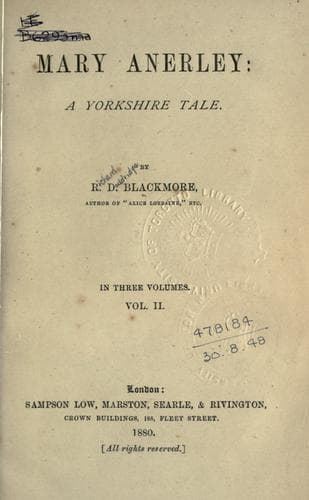
Mary Anerley: A Yorkshire TaleBlackmore, R. D. (Richard Doddridge)
General
Mary Anerley: A Yorkshire Tale
Blackmore, R. D. (Richard Doddridge)
Yorkshire (England) -- Fiction
“His master is out in the snow,” cried Bert; “perhaps buried in the
snow, and he is come to tell us. Give me my hat, child, and my thick
coat. See how delighted he is, poor fellow! Oh, here comes Maunder! Now
lead the way, my friend. Maunder, go and fetch the other shovel.
There is somebody lost in the snow, I believe. We must follow this dog
immediately.”
“Not till you both have had much plenty food,” the mother said: “out
upon the moors, this bad, bad night, and for leagues possibly to travel.
My son and my husband are much too good. You bad dog, why did you come,
pestilent? But you shall have food also. Insie, provide him. While I
make to eat your father and your brother.”
Saracen would hardly wait, starving as he was; but seeing the men
prepare to start, he made the best of it, and cleared out a colander of
victuals in a minute.
“Put up what is needful for a starving traveller,” Mr. Bert said to the
ladies. “We shall want no lantern; the snow gives light enough, and
the moon will soon be up. Keep a kettle boiling, and some warm clothes
ready. Perhaps we shall be hours away; but have no fear. Maunder is the
boy for snow-drifts.”
The young man being of a dark and silent nature, quite unlike his
father's, made no reply, nor even deigned to give a smile, but seemed to
be wonderfully taken with the dog, who in many ways resembled him. Then
he cast both shovels on his shoulder at the door, and strode forth,
and stamped upon the path that he had cleared. His father took a stout
stick, the dog leaped past them, and led them out at once upon the open
moor.
“We are in for a night of it,” said Mr. Bert, and his son did not
contradict him.
“The dog goes first, then I, then you,” he said to his father, with his
deep slow tone. And the elderly man, whose chief puzzle in life--since
he had given up the problem of the world--was the nature of his only
son, now wondered again, as he seldom ceased from wondering, whether
this boy despised or loved him. The young fellow always took the very
greatest care of his father, as if he were a child to be protected, and
he never showed the smallest sign of disrespect. Yet Maunder was not the
true son of his father, but of some ancestor, whose pride sprang out
of dust at the outrageous idea of a kettle-mending Bert, and embodied
itself in this Maunder.
The large-minded father never dreamed of such a trifle, but felt in such
weather, with the snow above his leggings, that sometimes it is good to
have a large-bodied son.
CHAPTER XLII
A CLEW OF BUTTONS
Public-domain text, read in full here on John Shaqi.
Reviews
Reviews
No reviews yet
Be the first to share your thoughts on this work.
Elsewhere in the archive
Join the Discussion
Join the discussion
Sign in to leave a comment or review.
Sign InorCreate an account